Deep Sleep Shield Update
-
@bucknall Thanks for the pictures.
The deep sleep shield picture in the documentation must by like this, with the little 6 pin component on top center and the 2 twins components (3 pins) at bottom right !
Can you change the documentation picture ?
Thanks for all the documentation readers.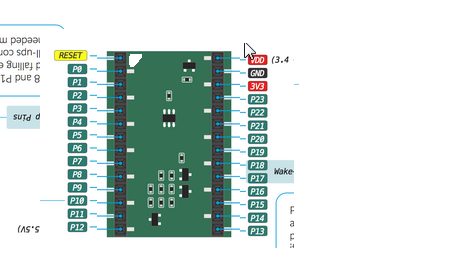 .
-
@dClaus Ahh ok yep - I'll get this changed! Thanks for the advice!
-
What is the purpose of this deepsleep shield? Is it required for LOPY and LOPY OEM?
-
@Colateral
It's needed because the deepsleep current was high on the LoPy (the L01 OEM module is fine): https://forum.pycom.io/topic/1022/root-causes-of-high-deep-sleep-current/1 -
Got my shield last week, thank you!
-
I was a late comer to adding my name for getting a deep sleep shield for my LoPy. I did the survey monkey survey. How can I tell if Pycom has me on their list of folks to send shields to?
-
I have not yet received my Deep Sleep Shields from my old orders :(
-
There seems to be a conflict with the deep sleep lib and I2C, both use pin 10. Can the deep sleep shield be used with another pin?
Should they be used sequentially, one after another to re-purpose pin usage?
For example, sequential logic would be:
- LoPy turns on
- use pin 10 for I2C's SCL
- after reading, use pin 10 for deep sleep
- on wake, restart logic flow
Does this have any implications (potential damage) for sensors connected to I2C bus?
-
@ledbelly2142 P10 is communicating with the PIC that yanks power off/on to the WiPy/LoPy via Q1. (see schematic - hope I am not teaching grandma how to suck eggs)
I could not make both work at the same time, but I did not try unloading the deepsleep module for sequential operation with I2C. Instead I moved SCL from P10 to P8 which works fine. In addition, I had to spin my mating PCB to use P8 (grr).
In general, more explanation of the Deep Sleep Shield's design and inner working would be helpful for folks like myself that are not hardware savvy. I've seen a fair number of forum posts that begin with confusion about how the shield works and what can't be done when using it.
I have been running a 3V3 BME280 I2C sensor and have seen no issues from power cycling with deepsleep operation. The system has been in continuous operation for a few weeks, power cycling every minute. Initially I had brownouts when the LoPy booted with sensor loads attached (I2C and others) to the LoPy 3V3 pin. A cap on the 5V and 3V3 did not help ( appears to be a ESP32 issue with the brownout detector), so I added a high side switch to sequence power to the sensors, similar to the shield. If you don't see the brownout detector firing - it is not needed.
I think some of the shortcomings of the deepsleep implementation could be addressed with the PIC code - I have not found the source for the PIC - another post discusses reverse engineering the code so I suspect it is not available. I'd rather replace the deepsleep hardware design and eliminate the PIC or move to the OEM module, than try to reverse the PIC code. TI and others make IC's specifically for this use case.
Overall I am pretty happy with the shield as a countermeasure - I can always use a bigger battery/solar panel if the sleep current is still too high. Would help to understand it better.
-
@lambda280
Thanks for your response.
I am also using a BME280. What did you do to use P8 for SCL?Did you edit the I2C lib or redefine the pin in your main.py?
-
@ledbelly2142 My code extends the BME280.py driver linked to in this forum (a pythonized version of existing c++ drivers). The gist is given in the pycom documentation for I2C - you pass in a tuple for the "pins" keyword:
i2c.init(I2C.MASTER, baudrate=100000, pins=('P8', 'P9'))
In this example, 'P8' being the SDA line, 'P9' being the SCL. I happen to be using those two at the moment as they simplified routing on my mating PCB. I was using ('P9','P8') prior to this and they work fine, just make sure they are connected to the corresponding pins on the BME280. I don't believe "any" pin combination will work - you either have to get familiar with the ESP32 and the pins in use by the LoPy, or just use trial and error, or my case, trial and smoke.
I needed to drop the baud rate to 100K to work with the BME280 (Embedded Adventures). I have ~ 10 cm of wiring between the LoPy and BME - perhaps that is why. When working with I2C, it is helpful to have a device you are very familiar with to debug your connection setup, then switch in the new driver and sensor. Going step by step and using the REPL is your friend in this regard.
-
@lambda280
I am using @Butch 's BME280 lib from HEREIf I can get away with using P10 sequentially I will. Moving SCL to another pin is a great alternative. My BME280's are pretty close, about 5cm, but they are plugged into the LoPy expansion shield pin headders, which have some 'play' in them (not a solid connection). I would prefer to solder them somewhere for impact testing. What's hot glue for anyway :-)
I'm using a fully made breakout BME280 board from HERE
@jmarcelino thought moving the I2C pins is best, since you can't move the deep sleep shield pin 10. -Thank you!
in the main.py I added the pin assignment:
i2c = I2C(0, I2C.MASTER, baudrate=100000, pins=('P8','P9'))Works fine now.

Hello! It looks like you're interested in this conversation, but you don't have an account yet.
Getting fed up of having to scroll through the same posts each visit? When you register for an account, you'll always come back to exactly where you were before, and choose to be notified of new replies (either via email, or push notification). You'll also be able to save bookmarks and upvote posts to show your appreciation to other community members.
With your input, this post could be even better 💗
Register Login