Lopy Nano-Gateway
-
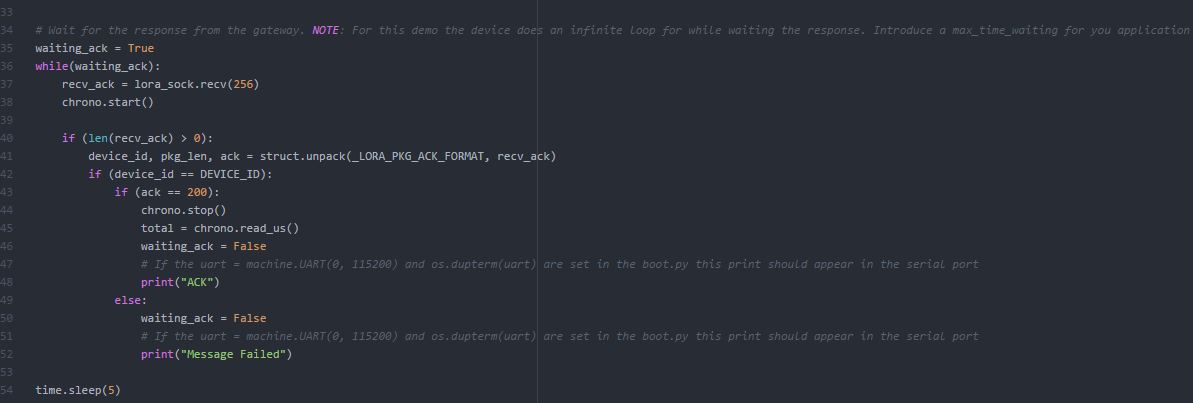
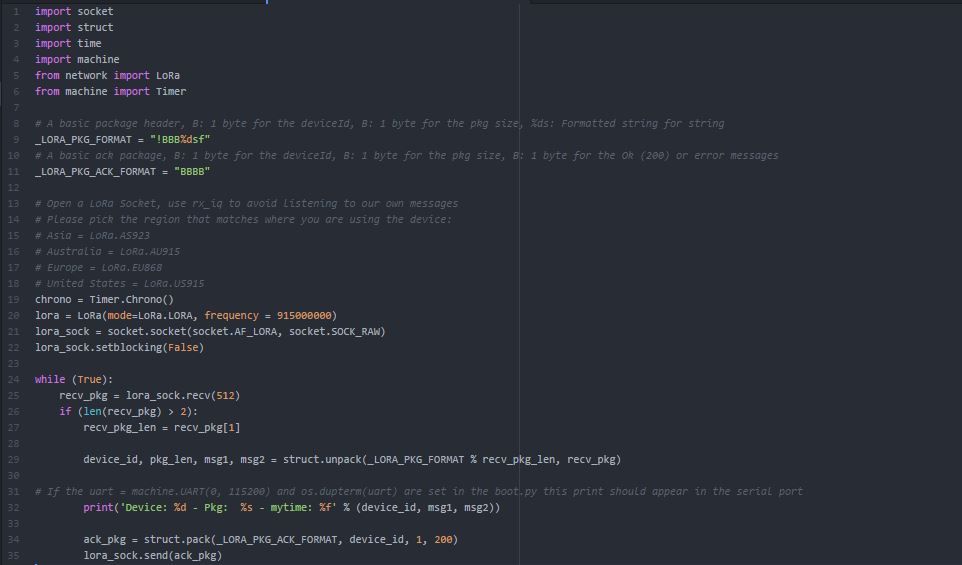
Hi, currently i am using the code from https://docs.pycom.io/chapter/tutorials/lopy/lora-mac-nano-gateway.html and i have adding in some code to suit my application which is measure the time of receiving the ACK from the gateway by adding the Timer and send back the time value back to gateway. Unfortunately, i face the problems. Sorry for the unprofessional coding way since i am still new in programming.
Gateway code :

For Node 1:


- the coding for node 1 and node 2 is the same instead of the Device ID.
Any help from others would appreciate, thank you.
-
@mj The code is hard to see the way you post it. if you enclose it in lines with three backticks each (```) you can paste you code directly in the message.
-
Hi, @robert-hh sorry for the inconvenient caused. Here is the code:
Gateway :
import socket
import struct
import time
import machine
from network import LoRa
from machine import Timer
# A basic package header, B: 1 byte for the deviceId, B: 1 byte for the pkg size, %ds: Formatted string for string`
_LORA_PKG_FORMAT = "!BB%dsf"
# A basic ack package, B: 1 byte for the deviceId, B: 1 byte for the pkg size, B: 1 byte for the Ok (200) or error messages
_LORA_PKG_ACK_FORMAT = "BBB"

# Open a LoRa Socket, use rx_iq to avoid listening to our own messages`
`# Please pick the region that matches where you are using the device:
# Asia = LoRa.AS923
# Australia = LoRa.AU915
# Europe = LoRa.EU868
# United States = LoRa.US915
chrono = Timer.Chrono()
lora = LoRa(mode=LoRa.LORA, frequency = 915000000)
lora_sock = socket.socket(socket.AF_LORA, socket.SOCK_RAW)
lora_sock.setblocking(False)

while (True):
    recv_pkg = lora_sock.recv(512)
    if (len(recv_pkg) > 2):
        recv_pkg_len = recv_pkg[2]

        device_id, pkg_len, msg = struct.unpack(_LORA_PKG_FORMAT % recv_pkg_len, recv_pkg)

# If the uart = machine.UART(0, 115200) and os.dupterm(uart) are set in the boot.py this print should appear in the serial port
        print('Device: %d - Pkg:  %s' % (device_id, msg))

        ack_pkg = struct.pack(_LORA_PKG_ACK_FORMAT, device_id, 1, 200)
        lora_sock.send(ack_pkg)
Node :
import os
import socket
import time
import struct
import machine
import network
from network import LoRa
from machine import Timer

# A basic package header, B: 1 byte for the deviceId, B: 1 byte for the pkg size
_LORA_PKG_FORMAT = "BB%dsf"
_LORA_PKG_ACK_FORMAT = "BBB"
DEVICE_ID = 0x01

# Open a Lora Socket, use tx_iq to avoid listening to our own messages
# Please pick the region that matches where you are using the device:
# Asia = LoRa.AS923
# Australia = LoRa.AU915
# Europe = LoRa.EU868
# United States = LoRa.US915
chrono = Timer.Chrono()
lora = LoRa(mode=LoRa.LORA, frequency = 915000000)
lora_sock = socket.socket(socket.AF_LORA, socket.SOCK_RAW)
lora_sock.setblocking(False)

while(True):
    # Package send containing a simple string
    msg1 = "Device 1 Here"
    msg2 = "Time difference %f total"
    msg = "format_string % (msg1,msg2)"
    pkg = struct.pack(_LORA_PKG_FORMAT % len(msg), DEVICE_ID, len(msg), msg)
    lora_sock.send(pkg)

    # Wait for the response from the gateway. NOTE: For this demo the device does an infinite loop for while waiting the response. Introduce a max_time_waiting for you application
    waiting_ack = True
    while(waiting_ack):
        recv_ack = lora_sock.recv(256)
        chrono.start()

        if (len(recv_ack) > 0):
            device_id, pkg_len, ack = struct.unpack(_LORA_PKG_ACK_FORMAT, recv_ack)
            if (device_id == DEVICE_ID):
                if (ack == 200):
                    chrono.stop()
                    total = chrono.read_us()
                    waiting_ack = False
                    # If the uart = machine.UART(0, 115200) and os.dupterm(uart) are set in the boot.py this print should appear in the serial port
                    print("ACK")
                else:
                    waiting_ack = False
                    # If the uart = machine.UART(0, 115200) and os.dupterm(uart) are set in the boot.py this print should appear in the serial port
                    print("Message Failed")

    time.sleep(5)
The problem that i face is the : "buffer too small " , "cannot convert str to int", "3 more values to unpack" . I have no idea on how it works since i am still new in python programming, any help would appreciate. Thank you.
-
@mj I do not know what you intention was, but may something like this, which just changes the message content and initializes total for the first run.
import os
import socket
import time
import struct
import machine
import network
from network import LoRa
from machine import Timer

# A basic package header, B: 1 byte for the deviceId, B: 1 byte for the pkg size
_LORA_PKG_FORMAT = "BB%ds"
_LORA_PKG_ACK_FORMAT = "BBB"
DEVICE_ID = 0x01

# Open a Lora Socket, use tx_iq to avoid listening to our own messages
# Please pick the region that matches where you are using the device:
# Asia = LoRa.AS923
# Australia = LoRa.AU915
# Europe = LoRa.EU868
# United States = LoRa.US915
chrono = Timer.Chrono()
lora = LoRa(mode=LoRa.LORA, frequency = 915000000)
lora_sock = socket.socket(socket.AF_LORA, socket.SOCK_RAW)
lora_sock.setblocking(False)
total = 0

while(True):
    # Package send containing a simple string
    msg = "Device 1 Here, Time difference %d total" % total
    pkg = struct.pack(_LORA_PKG_FORMAT % len(msg), DEVICE_ID, len(msg), msg)
    lora_sock.send(pkg)

    # Wait for the response from the gateway. NOTE: For this demo the device does an infinite loop for while waiting the response. Introduce a max_time_waiting for you application
    waiting_ack = True
    while(waiting_ack):
        recv_ack = lora_sock.recv(256)
        chrono.start()

        if (len(recv_ack) > 0):
            device_id, pkg_len, ack = struct.unpack(_LORA_PKG_ACK_FORMAT, recv_ack)
            if (device_id == DEVICE_ID):
                if (ack == 200):
                    chrono.stop()
                    total = chrono.read_us()
                    waiting_ack = False
                    # If the uart = machine.UART(0, 115200) and os.dupterm(uart) are set in the boot.py this print should appear in the serial port
                    print("ACK")
                else:
                    waiting_ack = False
                    # If the uart = machine.UART(0, 115200) and os.dupterm(uart) are set in the boot.py this print should appear in the serial port
                    print("Message Failed")

    time.sleep(5)

Hello! It looks like you're interested in this conversation, but you don't have an account yet.
Getting fed up of having to scroll through the same posts each visit? When you register for an account, you'll always come back to exactly where you were before, and choose to be notified of new replies (either via email, or push notification). You'll also be able to save bookmarks and upvote posts to show your appreciation to other community members.
With your input, this post could be even better 💗
Register Login