Welcome to the Pycom forum Forum
    • \[\[global:header.categories\]\]
    • \[\[global:header.recent\]\]
    • \[\[global:header.tags\]\]
    • \[\[global:header.popular\]\]
    • Login

    Explore Pybytes | Official Documentation | Report a Firmware Bug/Issue | GitHub

    Pytrack GPS API

    Scheduled Pinned Locked Moved Enhancements
    pytrack
    51 Posts 13 Posters 16.1k Views 20 Watching
    Loading More Posts
    • Oldest to Newest
    • Newest to Oldest
    • Most Votes
    Reply
    • Reply as topic
    Log in to reply
    This topic has been deleted. Only users with topic management privileges can see it.
    • A Offline
      andrethemac @Neuromystix
      last edited by

      @neuromystix I used to search the nmea messages with _read looking for xxGGA until a fix was found. Only then I use the l76.coordinates to find the exact position.
      a bit of a work around.
      The new library you posted works as a charm, no more memory errors.
      The Quectel is a bit "slow" but with a timeout of 180 (3 minutes), I manage to get a fix (almost) every time the wipy/lopy comes awake (after deep sleep). Not so good for the battery, 3 minutes on +- 70 mA vs 390 uA in deep sleep with the pytrack. The 390 uA are probably from the accelerator, I use the accelerator to wake up the unit when it gets more than 2g for over a second.

      N 1 Reply Last reply Reply Quote 0
      • N Offline
        Neuromystix @andrethemac
        last edited by

        @andrethemac i followed the original lib which use gc to clean memory. But haven't tried any other options.
        Same problem here with the starting time. Sometimes i just unplug the cable from my computer and plug it to a powerbank and have to wait 5 minutes for it to get fix. For my project this will not be a problem but for a battery operated device it's not a good thing...

        Researcher @ UALG, Portugal

        A 1 Reply Last reply Reply Quote 0
        • G Offline
          gregcope @Neuromystix
          last edited by

          @neuromystix Works like a champ - it would be good if this was added to the main lib. I added HDOP (GPGGA) as that is a good indication of accuracy.

          1 Reply Last reply Reply Quote 0
          • M Offline
            mwtidd @Neuromystix
            last edited by

            @neuromystix your work has been awesome. Thank you so much for your efforts. In running some test logs earlier today, I found that I got a series of fixes logged that were "invalid". Upon reviewing you code the protocol documents, I have one update to propose

            def _fix_quality(self, gngga_s):
                valid = gngga_s[6]
                if valid == '0':
                    return False
                else:
                    return True
            

            Your initial fix quality function only returned true if gngga_s[6] was 1, however it seems that values such as 2 or 3 may be valid as well.

            Per v2.2 of the protocol spec:

            Value Description
            0 Fix not available or invalid
            1 GPS SPS Mode, fix valid
            2 Differential GPS, SPS Mode, fix valid
            3 GPS PPS Mode, fix valid

            Once again, thanks for your efforts. Just wanted to share my findings.

            N 1 Reply Last reply Reply Quote 0
            • N Offline
              Neuromystix @mwtidd
              last edited by

              @mwtidd When i wrote it i was reading the "Quectel l76 Series GNSS protocol Specification V3.3" which says (@page 12):
              Fix Status
              "0"=Invalid
              "1"=GNSS fix
              "2"=DGPS fix
              "6"=Estimated (dead reckoning) mode

              That's why i only used "1". But even with that, we can use the value "2" for the DGPS fix. I haven´t checked if i had some fixes "2" ou another values. If it worked for you, nice ;)

              Best regards
              Nelson Pinto

              Researcher @ UALG, Portugal

              1 Reply Last reply Reply Quote 0
              • S Offline
                stefan85e @bmarkus
                last edited by

                @bmarkus said in Pytrack GPS API:

                umber of satellites visible /used for fi

                • number of satellites visible /used for fix - Is this possible yet?!
                N 1 Reply Last reply Reply Quote 0
                • N Offline
                  Neuromystix @stefan85e
                  last edited by

                  @stefan85e If you need the number of satellites used to fix, it's already parsed in l76.coordinates1(). The "Satellites in view" i haven't done it, but it's easy to implement, just parse any $__GSV sentence, the third field is "Satellites in view".

                  Researcher @ UALG, Portugal

                  S 1 Reply Last reply Reply Quote 0
                  • S Offline
                    stefan85e @Neuromystix
                    last edited by

                    @neuromystix said in Pytrack GPS API:

                    l76.coordinates1()

                    Sorry did not udnerstand that :)

                    1 Reply Last reply Reply Quote 0
                    • A Offline
                      andrethemac
                      last edited by

                      Hi all. I've taken the original librarya and @Neuromystix addtions and made my own library. It parses aml the sentences from the L76 gps and returns them as a dict. you can get the coordinates parsed, the time, ...
                      https://github.com/andrethemac/L76GLNSV4

                      I've noticed one (strange?) thing. the RMC (required minimum data to get a fix) message only pass once (just after starting the gps) and does not reappear. Any idea's ?
                      best regards

                      S 1 Reply Last reply Reply Quote 0
                      • S Offline
                        stefan85e @Neuromystix
                        last edited by

                        @neuromystix said in Pytrack GPS API:

                        For use it just call l76.coordinates1() which will return (lat, long, time(not formatted), altitude (M), valid fix (true ou false), number of satellites).
                        L76GNSS.py
                        So what did you do to get the nimber of satellites? We are trying this and we cant get it to work.

                        N 1 Reply Last reply Reply Quote 0
                        • N Offline
                          Neuromystix @stefan85e
                          last edited by

                          @stefan85e Hello,

                          You have to do something like this inside your code, and you'll get the number of satellites used for fix:

                          ...
                          gps_data = l76.coordinates1()
                          n_sat = gps_data[5]
                          ...
                          

                          Or you can use the @andrethemac library which will get you all the data ;)

                          Researcher @ UALG, Portugal

                          1 Reply Last reply Reply Quote 0
                          • S Offline
                            stefan85e @andrethemac
                            last edited by

                            @andrethemac
                            (2018, 4, 17, 11, 29, 12, 564887, None)(None(53.33632, 12.53262)
                            (None, None) Got when I add this:

                            gps_data = l76.coordinates1()
                            n_sat = gps_data[5]

                            Did also try to use this lib:
                            https://github.com/andrethemac/L76GLNSV4

                            A 1 Reply Last reply Reply Quote 0
                            • S Offline
                              stefan85e @Neuromystix
                              last edited by

                              @neuromystix said in Pytrack GPS API:

                              num_satellites

                              Does this work:

                              return(lat_d, lon_d, gps_time, gps_altitude, valid, num_satellites)

                              I want num_satellites...

                              N 1 Reply Last reply Reply Quote 0
                              • N Offline
                                Neuromystix @stefan85e
                                last edited by

                                @stefan85e If you are using my code (and just my code, not the one from @andrethemac), when you call gps_data = l76.coordinates1() it will return a list gps_data with latitude at first position (gps_data[0]), longitude at second (gps_data[1]), and so on till the sixth position where you get the number of satellites (gps_data[5]). So, number_of_satellites = gps_data[5].

                                Researcher @ UALG, Portugal

                                1 Reply Last reply Reply Quote 0
                                • A Offline
                                  andrethemac @stefan85e
                                  last edited by

                                  @stefan85e An example on how to get the number of satelites with my library

                                  from pytrack import Pytrack
                                  from L76GNSV4 import L76GNSS
                                  
                                  py = Pytrack()
                                  L76 = L76GNSS(pytrack=py)
                                  
                                  print("test L76")
                                  # returns the info about sattelites in view at this moment
                                  # even without the gps being fixed
                                  print(L76.gps_message('GSV'))
                                  
                                  # returns the number of sattelites in view at this moment
                                  # even without the gps being fixed
                                  print(L76.gps_message('GGA')['NumberOfSV'])
                                  
                                  # returns the coordinates
                                  # with debug true you see the messages parsed by the 
                                  # library until you get a the gps is fixed
                                  print(L76.coordinates(debug=True))
                                  #L76.getUTCDateTime(debug=True)
                                  #L76._read_message(debug=True)
                                  
                                  
                                  S 1 Reply Last reply Reply Quote 1
                                  • S Offline
                                    stefan85e @andrethemac
                                    last edited by stefan85e

                                    @andrethemac

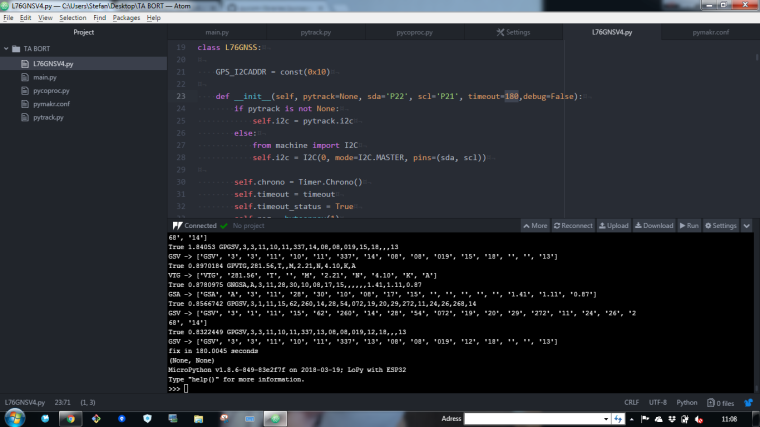
                                    0_1524042540467_f2c4b355-5786-4440-8e0e-6e4ab4d095d0-image.png

                                    Got this

                                    I see that you have a 180 timeout in the code:

                                    -> L76GNSV4 - So how do I know how many sattelites i have then :) just so I look at right nr :)

                                    ´´´´
                                    def init(self, pytrack=None, sda='P22', scl='P21', timeout=180,debug=False):
                                    ´´´´

                                    A 1 Reply Last reply Reply Quote 0
                                    • A Offline
                                      andrethemac @stefan85e
                                      last edited by

                                      @stefan85e The timeout is to prevent the library to wait for ever. 180 seconds (3 minutes) is (for me) most of the time enough to get a fixed location. (that is after a cold start)
                                      the GGA sentences contains the number of messages seen by the GPS, In the dict that GGA returns, this is the "NumberOfSV' fied.
                                      with this you get this number -> L76.gps_message('GGA')['NumberOfSV']
                                      In your screenshot the line that prints the number of satellites has scrolled out of view
                                      but if you make this line the last you get the number:
                                      print(L76.gps_message('GGA')['NumberOfSV'])
                                      or remove the 'debug=True) from the coordinates line (the debug spews out a lot of information)
                                      I'm still working on the library to make it faster
                                      best regards

                                      A S 2 Replies Last reply Reply Quote 0
                                      • A Offline
                                        andrethemac @andrethemac
                                        last edited by

                                        @andrethemac published a new version of the Library to github
                                        https://github.com/andrethemac/L76GLNSV4

                                        If you find some errors or have a request, please ask.
                                        best regards

                                        S 2 Replies Last reply Reply Quote 0
                                        • S Offline
                                          stefan85e @andrethemac
                                          last edited by

                                          @andrethemac

                                          The program stop after 180 sec and if I do this:

                                          #print(L76.coordinates(debug=True)) it will not do anything :)
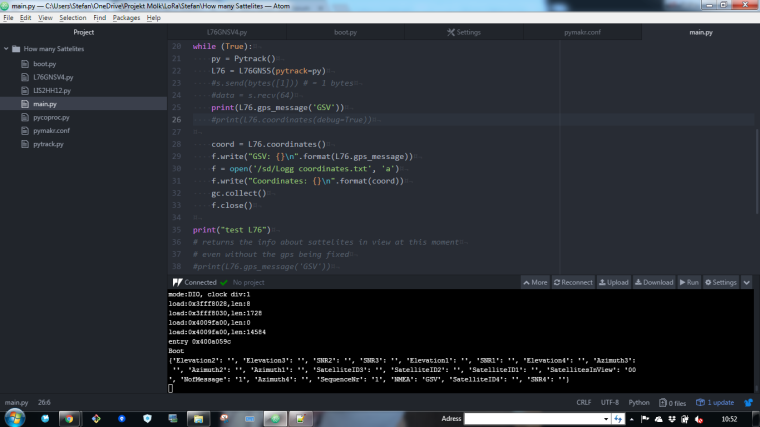
                                          0_1524127959536_b577631a-0d05-460c-906e-6afe4d29af99-image.png

                                          1 Reply Last reply Reply Quote 0
                                          • S Offline
                                            stefan85e @andrethemac
                                            last edited by

                                            This post is deleted!
                                            1 Reply Last reply Reply Quote 0

                                            Hello! It looks like you're interested in this conversation, but you don't have an account yet.

                                            Getting fed up of having to scroll through the same posts each visit? When you register for an account, you'll always come back to exactly where you were before, and choose to be notified of new replies (either via email, or push notification). You'll also be able to save bookmarks and upvote posts to show your appreciation to other community members.

                                            With your input, this post could be even better 💗

                                            Register Login
                                            • 1
                                            • 2
                                            • 3
                                            • 3 / 3
                                            • First post
                                              Last post

                                            Pycom on Twitter

                                            Pycom