Welcome to the Pycom forum Forum
    • \[\[global:header.categories\]\]
    • \[\[global:header.recent\]\]
    • \[\[global:header.tags\]\]
    • \[\[global:header.popular\]\]
    • Login

    Explore Pybytes | Official Documentation | Report a Firmware Bug/Issue | GitHub

    External SD Card

    Scheduled Pinned Locked Moved MicroPython
    sd card
    22 Posts 6 Posters 8.8k Views 6 Watching
    Loading More Posts
    • Oldest to Newest
    • Newest to Oldest
    • Most Votes
    Reply
    • Reply as topic
    Log in to reply
    This topic has been deleted. Only users with topic management privileges can see it.
    • M Offline
      Manju2391
      last edited by

      @livius
      Yes I did import the library and when tried to test it but i'm getting this error

      import machine, sdcard, os
      from machine import SPI
      from machine import Pin

      spi = SPI(0, mode=SPI.MASTER, baudrate=2000000, polarity=0, phase=0, pins=('P19','P20','P21'))
      CS = Pin('P10', mode=Pin.OUT, pull=Pin.PULL_UP)
      sd = sdcard.SDCard(machine.SPI(0), machine.Pin('P22'))

      Traceback (most recent call last):
      File "<stdin>", line 9, in <module>
      File "/flash/lib/sdcard.py", line 54, in init
      File "/flash/lib/sdcard.py", line 79, in init_card
      File "/flash/lib/sdcard.py", line 133, in cmd
      AttributeError: 'Pin' object has no attribute 'low'

      MicroPython v1.8.6-839-g536c958c on 2017-11-15; LoPy with ESP32
      Type "help()" for more information.

      L 1 Reply Last reply Reply Quote 0
      • L Offline
        livius @Manju2391
        last edited by

        @manju2391
        you must addapt it to pycom sources
        instead low() write value(0)

        think about people first, then computers

        robert-hhR 1 Reply Last reply Reply Quote 0
        • robert-hhR Offline
          robert-hh @livius
          last edited by

          @livius And value(1) instead of high().
          That was a confusing change in the API, which broke a lot of code.

          M 1 Reply Last reply Reply Quote 0
          • M Offline
            Manju2391 @robert-hh
            last edited by

            @robert-hh @livius
            I did change the values according to pycom sources but still its not liking it. I'm getting this error
            File "/flash/sd.py", line 9
            File "/flash/lib/sdcard.py", line 54, in_init_
            File "/flash/lib/sdcard.py", line 79, in init_card
            File "/flash/lib/sdcard.py", line 147, in cmd
            Typeerror: extra positional arguments given

            robert-hhR 1 Reply Last reply Reply Quote 0
            • robert-hhR Offline
              robert-hh @Manju2391
              last edited by

              @manju2391 It seems that this library is a little bit outdated. I know that I used this on an esp8266, and it worked. And the version on the micropython.org site seems to be a little bit more recent. (https://github.com/micropython/micropython/tree/master/drivers/sdcard). I can check, but not before the evening, which is in about 8 hours.

              M 1 Reply Last reply Reply Quote 0
              • M Offline
                Manju2391 @robert-hh
                last edited by

                @robert-hh
                Is there any possibility to interface the SD card over shared SPI bus without using any
                libraries? I have been getting my head around the SPI module from last week and I haven't got it yet. Not a problem @robert-hh you can let me know how it goes after testing

                robert-hhR 1 Reply Last reply Reply Quote 0
                • robert-hhR Offline
                  robert-hh @Manju2391
                  last edited by robert-hh

                  @manju2391 I tried that driver, and I got it to the point where it showed some activity. The code is below. The sdcard SPI is connected to:
                  P9 (SS), P10(Clk), P11(MOSI) and P12 (MISO). It is started with:

                  import sdcard, machine, os
                  
                  sd = sdcard.SDCard(machine.SPI(0), machine.Pin("P9"))
                  os.mount(sd, "/card")
                  

                  But it is very unstable, runs at low speed only, and data read from the card contains the byte sequence "\x7f\x04" here and there. And sometimes lopy simply crashed. So it's nothing really usable at the moment.
                  I tried that with two different SD card adapters. One with embedded bus drivers, which is like the one you have, and one which is simply wiring. The latter runs well when connected to the genuine SD card pins of the xxPy, using the built-in SD card module.

                  """
                  MicroPython driver for SD cards using SPI bus.
                  
                  Requires an SPI bus and a CS pin.  Provides readblocks and writeblocks
                  methods so the device can be mounted as a filesystem.
                  
                  Example usage on xxPy:
                  
                      import machine, sdcard, os
                      sd = sdcard.SDCard(machine.SPI(0), machine.Pin("P9"))
                      os.mount(sd, '/sd2')
                      os.listdir('/sd2')
                  
                  
                  """
                  
                  from micropython import const
                  import time
                  
                  
                  _CMD_TIMEOUT = const(100)
                  
                  _R1_IDLE_STATE = const(1 << 0)
                  #R1_ERASE_RESET = const(1 << 1)
                  _R1_ILLEGAL_COMMAND = const(1 << 2)
                  #R1_COM_CRC_ERROR = const(1 << 3)
                  #R1_ERASE_SEQUENCE_ERROR = const(1 << 4)
                  #R1_ADDRESS_ERROR = const(1 << 5)
                  #R1_PARAMETER_ERROR = const(1 << 6)
                  _TOKEN_CMD25 = const(0xfc)
                  _TOKEN_STOP_TRAN = const(0xfd)
                  _TOKEN_DATA = const(0xfe)
                  
                  
                  class SDCard:
                      def __init__(self, spi, cs):
                          self.spi = spi
                          self.cs = cs
                  
                          self.cmdbuf = bytearray(6)
                          self.dummybuf = bytearray(512)
                          for i in range(512):
                              self.dummybuf[i] = 0xff
                          self.dummybuf_memoryview = memoryview(self.dummybuf)
                  
                          # initialise the card
                          self.init_card()
                  
                      def init_spi(self, baudrate):
                          master = self.spi.MASTER
                          self.spi.init(master, baudrate=baudrate, phase=0, polarity=0)
                  
                      def init_card(self):
                          # init CS pin
                          self.cs.init(self.cs.OUT, value=1)
                  
                          # init SPI bus; use low data rate for initialisation
                          self.init_spi(100000)
                  
                          # clock card at least 100 cycles with cs high
                          for i in range(16):
                              self.spi.write(b'\xff')
                  
                          # CMD0: init card; should return _R1_IDLE_STATE (allow 5 attempts)
                          for _ in range(5):
                              if self.cmd(0, 0, 0x95) == _R1_IDLE_STATE:
                                  break
                          else:
                              raise OSError("no SD card")
                  
                          # CMD8: determine card version
                          r = self.cmd(8, 0x01aa, 0x87, 4)
                          if r == _R1_IDLE_STATE:
                              self.init_card_v2()
                          elif r == (_R1_IDLE_STATE | _R1_ILLEGAL_COMMAND):
                              self.init_card_v1()
                          else:
                              raise OSError("couldn't determine SD card version")
                  
                          # get the number of sectors
                          # CMD9: response R2 (R1 byte + 16-byte block read)
                          if self.cmd(9, 0, 0, 0, False) != 0:
                              raise OSError("no response from SD card")
                          csd = bytearray(16)
                          self.readinto(csd)
                          if csd[0] & 0xc0 != 0x40:
                              raise OSError("SD card CSD format not supported")
                          self.sectors = ((csd[8] << 8 | csd[9]) + 1) * 2014
                          #print('sectors', self.sectors)
                  
                          # CMD16: set block length to 512 bytes
                          if self.cmd(16, 512, 0) != 0:
                              raise OSError("can't set 512 block size")
                  
                          # set to high data rate now that it's initialised
                          #self.init_spi(100000)
                          #self.init_spi(40000000)
                  
                      def init_card_v1(self):
                          for i in range(_CMD_TIMEOUT):
                              self.cmd(55, 0, 0)
                              if self.cmd(41, 0, 0) == 0:
                                  self.cdv = 512
                                  #print("[SDCard] v1 card")
                                  return
                          raise OSError("timeout waiting for v1 card")
                  
                      def init_card_v2(self):
                          for i in range(_CMD_TIMEOUT):
                              time.sleep_ms(50)
                              self.cmd(58, 0, 0, 4)
                              self.cmd(55, 0, 0)
                              if self.cmd(41, 0x40000000, 0) == 0:
                                  self.cmd(58, 0, 0, 4)
                                  self.cdv = 1
                                  #print("[SDCard] v2 card")
                                  return
                          raise OSError("timeout waiting for v2 card")
                  
                      def cmd(self, cmd, arg, crc, final=0, release=True):
                          self.cs(0)
                  
                          # create and send the command
                          buf = self.cmdbuf
                          buf[0] = 0x40 | cmd
                          buf[1] = arg >> 24
                          buf[2] = arg >> 16
                          buf[3] = arg >> 8
                          buf[4] = arg
                          buf[5] = crc
                          self.spi.write(buf)
                  
                          # wait for the response (response[7] == 0)
                          for i in range(_CMD_TIMEOUT):
                              response = self.spi.read(1, write=0xff)[0]
                              if not (response & 0x80):
                                  # this could be a big-endian integer that we are getting here
                                  for j in range(final):
                                      self.spi.write(b'\xff')
                                  if release:
                                      self.cs(1)
                                      self.spi.write(b'\xff')
                                  return response
                  
                          # timeout
                          self.cs(1)
                          self.spi.write(b'\xff')
                          return -1
                  
                      def cmd_nodata(self, cmd):
                          self.spi.write(cmd)
                          self.spi.read(1, write=0xff) # ignore stuff byte
                          for _ in range(_CMD_TIMEOUT):
                              if self.spi.read(1, write=0xff)[0] == 0xff:
                                  self.cs(1)
                                  self.spi.write(b'\xff')
                                  return 0    # OK
                          self.cs(1)
                          self.spi.write(b'\xff')
                          return 1 # timeout
                  
                      def readinto(self, buf):
                          self.cs(0)
                  
                          # read until start byte (0xff)
                          while self.spi.read(1, write=0xff)[0] != 0xfe:
                              pass
                  
                          # read data
                          mv = self.dummybuf_memoryview[:len(buf)]
                          self.spi.write_readinto(mv, buf)
                  
                          # read checksum
                          self.spi.write(b'\xff')
                          self.spi.write(b'\xff')
                  
                          self.cs(1)
                          self.spi.write(b'\xff')
                  
                      def write(self, token, buf):
                          self.cs(0)
                  
                          # send: start of block, data, checksum
                          self.spi.read(1, token)
                          self.spi.write(buf)
                          self.spi.write(b'\xff')
                          self.spi.write(b'\xff')
                  
                          # check the response
                          if (self.spi.read(1, 0xff)[0] & 0x1f) != 0x05:
                              self.cs(1)
                              self.spi.write(b'\xff')
                              return
                  
                          # wait for write to finish
                          while self.spi.read(1, 0xff)[0] == 0:
                              pass
                  
                          self.cs(1)
                          self.spi.write(b'\xff')
                  
                      def write_token(self, token):
                          self.cs(0)
                          self.spi.read(1, token)
                          self.spi.write(b'\xff')
                          # wait for write to finish
                          while self.spi.read(1, 0xff)[0] == 0x00:
                              pass
                  
                          self.cs(1)
                          self.spi.write(b'\xff')
                  
                      def count(self):
                          return self.sectors
                  
                      def readblocks(self, block_num, buf):
                          nblocks, err = divmod(len(buf), 512)
                          assert nblocks and not err, 'Buffer length is invalid'
                          if nblocks == 1:
                              # CMD17: set read address for single block
                              if self.cmd(17, block_num * self.cdv, 0) != 0:
                                  return 1
                              # receive the data
                              self.readinto(buf)
                          else:
                              # CMD18: set read address for multiple blocks
                              if self.cmd(18, block_num * self.cdv, 0) != 0:
                                  return 1
                              offset = 0
                              mv = memoryview(buf)
                              while nblocks:
                                  self.readinto(mv[offset : offset + 512])
                                  offset += 512
                                  nblocks -= 1
                              return self.cmd_nodata(b'\x0c') # cmd 12
                          return 0
                  
                      def writeblocks(self, block_num, buf):
                          nblocks, err = divmod(len(buf), 512)
                          assert nblocks and not err, 'Buffer length is invalid'
                          if nblocks == 1:
                              # CMD24: set write address for single block
                              if self.cmd(24, block_num * self.cdv, 0) != 0:
                                  return 1
                  
                              # send the data
                              self.write(_TOKEN_DATA, buf)
                          else:
                              # CMD25: set write address for first block
                              if self.cmd(25, block_num * self.cdv, 0) != 0:
                                  return 1
                              # send the data
                              offset = 0
                              mv = memoryview(buf)
                              while nblocks:
                                  self.write(_TOKEN_CMD25, mv[offset : offset + 512])
                                  offset += 512
                                  nblocks -= 1
                              self.write_token(_TOKEN_STOP_TRAN)
                          return 0
                  
                  M N 2 Replies Last reply Reply Quote 1
                  • M Offline
                    Manju2391 @robert-hh
                    last edited by

                    @robert-hh
                    Thanks for your reply robert and I'll try working on it today and will post if anything crashes up and I have one more doubt regarding the WLAN access point. I have created an access point and I want to connect to my AP whenever the boot.py loads up. I can connect as a station but not as an access point i tried using this syntax but whenever it boots up it's looking for wlan AP but couldn't find it and goes to deep sleep mode. My network is up and it runs when I run it externally but not during boot up.

                    from network import WLAN

                    wlan.init(mode=WLAN.STA_AP,ssid='AP')
                    wlan.init(ssid='AP',auth=(WLAN.WPA2,'xxxx'))
                    print(wlan.ifconfig())

                    Is the above syntax right?

                    robert-hhR 1 Reply Last reply Reply Quote 0
                    • robert-hhR Offline
                      robert-hh @Manju2391
                      last edited by

                      @manju2391 About WLAN: It could look like:

                      from network import WLAN
                      
                      wlan = WLAN(mode=WLAN.STA_AP)
                      wlan.connect(ssid='AP',auth=(WLAN.WPA2, 'xxxx'))
                      # from here on it's optional. It just takes a few moments to connect
                      for _ in range (200):
                          if wlan.isconnected():
                              print(wlan.ifconfig())
                              break
                          else:
                              time.sleep_ms(50)
                      else:
                          print("Could not connect")
                      
                      M 1 Reply Last reply Reply Quote 0
                      • M Offline
                        Manju2391 @robert-hh
                        last edited by

                        @robert-hh

                        I tried using SPI bus it is very slow. I had designed the pcb with spi pins but looks like it is not best so I’m just using the SDIO pins and changed the pcb. About the WLAN when I define wlan initially it is asking me for ap ssid at first I get an error saying ap ssid not given. I get the IP address when run locally and it connects to FileZilla but when it boots for the STA_AP it doesn’t print the IP address nor it connects to WLAN. It will be in idle state. I don’t know why it’s not connecting. I’m wondering should we create a station first and then an AP?

                        1 Reply Last reply Reply Quote 0
                        • N Offline
                          nathanh @robert-hh
                          last edited by nathanh

                          @robert-hh said in External SD Card:

                          """
                          MicroPython driver for SD cards using SPI bus.
                          
                          Requires an SPI bus and a CS pin.  Provides readblocks and writeblocks
                          methods so the device can be mounted as a filesystem.
                          
                          Example usage on xxPy:
                          
                              import machine, sdcard, os
                              sd = sdcard.SDCard(machine.SPI(0), machine.Pin("P9"))
                              os.mount(sd, '/sd2')
                              os.listdir('/sd2')
                          
                          
                          """
                          
                          from micropython import const
                          import time
                          
                          
                          _CMD_TIMEOUT = const(100)
                          
                          _R1_IDLE_STATE = const(1 << 0)
                          #R1_ERASE_RESET = const(1 << 1)
                          _R1_ILLEGAL_COMMAND = const(1 << 2)
                          #R1_COM_CRC_ERROR = const(1 << 3)
                          #R1_ERASE_SEQUENCE_ERROR = const(1 << 4)
                          #R1_ADDRESS_ERROR = const(1 << 5)
                          #R1_PARAMETER_ERROR = const(1 << 6)
                          _TOKEN_CMD25 = const(0xfc)
                          _TOKEN_STOP_TRAN = const(0xfd)
                          _TOKEN_DATA = const(0xfe)
                          
                          
                          class SDCard:
                              def __init__(self, spi, cs):
                                  self.spi = spi
                                  self.cs = cs
                          
                                  self.cmdbuf = bytearray(6)
                                  self.dummybuf = bytearray(512)
                                  for i in range(512):
                                      self.dummybuf[i] = 0xff
                                  self.dummybuf_memoryview = memoryview(self.dummybuf)
                          
                                  # initialise the card
                                  self.init_card()
                          
                              def init_spi(self, baudrate):
                                  master = self.spi.MASTER
                                  self.spi.init(master, baudrate=baudrate, phase=0, polarity=0)
                          
                              def init_card(self):
                                  # init CS pin
                                  self.cs.init(self.cs.OUT, value=1)
                          
                                  # init SPI bus; use low data rate for initialisation
                                  self.init_spi(100000)
                          
                                  # clock card at least 100 cycles with cs high
                                  for i in range(16):
                                      self.spi.write(b'\xff')
                          
                                  # CMD0: init card; should return _R1_IDLE_STATE (allow 5 attempts)
                                  for _ in range(5):
                                      if self.cmd(0, 0, 0x95) == _R1_IDLE_STATE:
                                          break
                                  else:
                                      raise OSError("no SD card")
                          
                                  # CMD8: determine card version
                                  r = self.cmd(8, 0x01aa, 0x87, 4)
                                  if r == _R1_IDLE_STATE:
                                      self.init_card_v2()
                                  elif r == (_R1_IDLE_STATE | _R1_ILLEGAL_COMMAND):
                                      self.init_card_v1()
                                  else:
                                      raise OSError("couldn't determine SD card version")
                          
                                  # get the number of sectors
                                  # CMD9: response R2 (R1 byte + 16-byte block read)
                                  if self.cmd(9, 0, 0, 0, False) != 0:
                                      raise OSError("no response from SD card")
                                  csd = bytearray(16)
                                  self.readinto(csd)
                                  if csd[0] & 0xc0 != 0x40:
                                      raise OSError("SD card CSD format not supported")
                                  self.sectors = ((csd[8] << 8 | csd[9]) + 1) * 2014
                                  #print('sectors', self.sectors)
                          
                                  # CMD16: set block length to 512 bytes
                                  if self.cmd(16, 512, 0) != 0:
                                      raise OSError("can't set 512 block size")
                          
                                  # set to high data rate now that it's initialised
                                  #self.init_spi(100000)
                                  #self.init_spi(40000000)
                          
                              def init_card_v1(self):
                                  for i in range(_CMD_TIMEOUT):
                                      self.cmd(55, 0, 0)
                                      if self.cmd(41, 0, 0) == 0:
                                          self.cdv = 512
                                          #print("[SDCard] v1 card")
                                          return
                                  raise OSError("timeout waiting for v1 card")
                          
                              def init_card_v2(self):
                                  for i in range(_CMD_TIMEOUT):
                                      time.sleep_ms(50)
                                      self.cmd(58, 0, 0, 4)
                                      self.cmd(55, 0, 0)
                                      if self.cmd(41, 0x40000000, 0) == 0:
                                          self.cmd(58, 0, 0, 4)
                                          self.cdv = 1
                                          #print("[SDCard] v2 card")
                                          return
                                  raise OSError("timeout waiting for v2 card")
                          
                              def cmd(self, cmd, arg, crc, final=0, release=True):
                                  self.cs(0)
                          
                                  # create and send the command
                                  buf = self.cmdbuf
                                  buf[0] = 0x40 | cmd
                                  buf[1] = arg >> 24
                                  buf[2] = arg >> 16
                                  buf[3] = arg >> 8
                                  buf[4] = arg
                                  buf[5] = crc
                                  self.spi.write(buf)
                          
                                  # wait for the response (response[7] == 0)
                                  for i in range(_CMD_TIMEOUT):
                                      response = self.spi.read(1, write=0xff)[0]
                                      if not (response & 0x80):
                                          # this could be a big-endian integer that we are getting here
                                          for j in range(final):
                                              self.spi.write(b'\xff')
                                          if release:
                                              self.cs(1)
                                              self.spi.write(b'\xff')
                                          return response
                          
                                  # timeout
                                  self.cs(1)
                                  self.spi.write(b'\xff')
                                  return -1
                          
                              def cmd_nodata(self, cmd):
                                  self.spi.write(cmd)
                                  self.spi.read(1, write=0xff) # ignore stuff byte
                                  for _ in range(_CMD_TIMEOUT):
                                      if self.spi.read(1, write=0xff)[0] == 0xff:
                                          self.cs(1)
                                          self.spi.write(b'\xff')
                                          return 0    # OK
                                  self.cs(1)
                                  self.spi.write(b'\xff')
                                  return 1 # timeout
                          
                              def readinto(self, buf):
                                  self.cs(0)
                          
                                  # read until start byte (0xff)
                                  while self.spi.read(1, write=0xff)[0] != 0xfe:
                                      pass
                          
                                  # read data
                                  mv = self.dummybuf_memoryview[:len(buf)]
                                  self.spi.write_readinto(mv, buf)
                          
                                  # read checksum
                                  self.spi.write(b'\xff')
                                  self.spi.write(b'\xff')
                          
                                  self.cs(1)
                                  self.spi.write(b'\xff')
                          
                              def write(self, token, buf):
                                  self.cs(0)
                          
                                  # send: start of block, data, checksum
                                  self.spi.read(1, token)
                                  self.spi.write(buf)
                                  self.spi.write(b'\xff')
                                  self.spi.write(b'\xff')
                          
                                  # check the response
                                  if (self.spi.read(1, 0xff)[0] & 0x1f) != 0x05:
                                      self.cs(1)
                                      self.spi.write(b'\xff')
                                      return
                          
                                  # wait for write to finish
                                  while self.spi.read(1, 0xff)[0] == 0:
                                      pass
                          
                                  self.cs(1)
                                  self.spi.write(b'\xff')
                          
                              def write_token(self, token):
                                  self.cs(0)
                                  self.spi.read(1, token)
                                  self.spi.write(b'\xff')
                                  # wait for write to finish
                                  while self.spi.read(1, 0xff)[0] == 0x00:
                                      pass
                          
                                  self.cs(1)
                                  self.spi.write(b'\xff')
                          
                              def count(self):
                                  return self.sectors
                          
                              def readblocks(self, block_num, buf):
                                  nblocks, err = divmod(len(buf), 512)
                                  assert nblocks and not err, 'Buffer length is invalid'
                                  if nblocks == 1:
                                      # CMD17: set read address for single block
                                      if self.cmd(17, block_num * self.cdv, 0) != 0:
                                          return 1
                                      # receive the data
                                      self.readinto(buf)
                                  else:
                                      # CMD18: set read address for multiple blocks
                                      if self.cmd(18, block_num * self.cdv, 0) != 0:
                                          return 1
                                      offset = 0
                                      mv = memoryview(buf)
                                      while nblocks:
                                          self.readinto(mv[offset : offset + 512])
                                          offset += 512
                                          nblocks -= 1
                                      return self.cmd_nodata(b'\x0c') # cmd 12
                                  return 0
                          
                              def writeblocks(self, block_num, buf):
                                  nblocks, err = divmod(len(buf), 512)
                                  assert nblocks and not err, 'Buffer length is invalid'
                                  if nblocks == 1:
                                      # CMD24: set write address for single block
                                      if self.cmd(24, block_num * self.cdv, 0) != 0:
                                          return 1
                          
                                      # send the data
                                      self.write(_TOKEN_DATA, buf)
                                  else:
                                      # CMD25: set write address for first block
                                      if self.cmd(25, block_num * self.cdv, 0) != 0:
                                          return 1
                                      # send the data
                                      offset = 0
                                      mv = memoryview(buf)
                                      while nblocks:
                                          self.write(_TOKEN_CMD25, mv[offset : offset + 512])
                                          offset += 512
                                          nblocks -= 1
                                      self.write_token(_TOKEN_STOP_TRAN)
                                  return 0
                          

                          I know this is a bit old but I just got an SD card module (https://www.sparkfun.com/products/13743) and was trying to get it working with my FiPy. I was running into a lot of issues but was able to make some headway using the library you pasted @robert-hh and thought I would share my results in case other people wanted to get it working.

                          However, I did have some errors with the library and had to make the following changes:

                          • The pins you used are not the default pins for the SPI init call. So I created my own SPI instance with the pin allocation you had in the post (since I already had them like that) and passed that instance into the SDCard constructor rather than machine.SPI(0). I also removed the additional spi init calls.

                          • I had to set the SPI baudrate to 1000000 instead of 100000

                          • I had to declare the CS pin as an instance outside of the library and pass it in similar to the SPI above.

                          • The command to check idle state at the start of the library self.cmd(0, 0, 0x95) would never return a value of 1. I don't know where the reference of these commands were but testing the other commands manually all returned values as expected. So I commented out the entire block that checks for the SD card or raises the 'no SD card' error. I found that I still need to run this command regardless, I get the same set of (4?) different values that repeat each time it is called. They never equal 1 but I let the code continue and command out the error block. Not calling the 0x95 command will not allow the next set of command to work correctly.

                          Doing the above I have gotten my external SD card board working fine with the FiPy. For reference below are my library and how I call it.

                          """
                          MicroPython driver for SD cards using SPI bus.
                          
                          Requires an SPI bus and a CS pin.  Provides readblocks and writeblocks
                          methods so the device can be mounted as a filesystem.
                          
                          Example usage on xxPy:
                          
                              import machine, sdcard, os
                              sd = sdcard.SDCard(machine.SPI(0), machine.Pin("P9"))
                              os.mount(sd, '/sd2')
                              os.listdir('/sd2')
                          
                          
                          """
                          
                          from micropython import const
                          import time
                          
                          
                          _CMD_TIMEOUT = const(100)
                          
                          _R1_IDLE_STATE = const(1 << 0)
                          #R1_ERASE_RESET = const(1 << 1)
                          _R1_ILLEGAL_COMMAND = const(1 << 2)
                          #R1_COM_CRC_ERROR = const(1 << 3)
                          #R1_ERASE_SEQUENCE_ERROR = const(1 << 4)
                          #R1_ADDRESS_ERROR = const(1 << 5)
                          #R1_PARAMETER_ERROR = const(1 << 6)
                          _TOKEN_CMD25 = const(0xfc)
                          _TOKEN_STOP_TRAN = const(0xfd)
                          _TOKEN_DATA = const(0xfe)
                          
                          
                          class SDCard:
                              def __init__(self, spi, cs):
                                  self.spi = spi
                                  self.cs = cs
                          
                                  self.cmdbuf = bytearray(6)
                                  self.dummybuf = bytearray(512)
                                  for i in range(512):
                                      self.dummybuf[i] = 0xff
                                  self.dummybuf_memoryview = memoryview(self.dummybuf)
                          
                                  # initialise the card
                                  self.init_card()
                          
                              def init_spi(self, baudrate):
                                  master = self.spi.MASTER
                                  self.spi.init(master, baudrate=baudrate, phase=0, polarity=0)
                          
                              def init_card(self):
                                  # init CS pin        
                                  #self.cs.init(self.cs.OUT, value=0)
                          
                                  # init SPI bus; use low data rate for initialisation
                                  #self.init_spi(100000)
                          
                                  # clock card at least 100 cycles with cs high
                                  for i in range(16):
                                      self.spi.write(b'\xff')
                          
                                  # CMD0: init card; should return _R1_IDLE_STATE (allow 5 attempts)
                                  
                                  for _ in range(5):
                                      if self.cmd(0, 0, 0x95) == _R1_IDLE_STATE:
                                          break
                                  '''
                                  else:
                                      raise OSError("no SD card")
                                  '''
                          
                                  # CMD8: determine card version
                                  r = self.cmd(8, 0x01aa, 0x87, 4)
                                  if r == _R1_IDLE_STATE:
                                      self.init_card_v2()
                                  elif r == (_R1_IDLE_STATE | _R1_ILLEGAL_COMMAND):
                                      self.init_card_v1()
                                  else:
                                      raise OSError("couldn't determine SD card version")
                          
                                  # get the number of sectors
                                  # CMD9: response R2 (R1 byte + 16-byte block read)
                                  if self.cmd(9, 0, 0, 0, False) != 0:
                                      raise OSError("no response from SD card")
                                  csd = bytearray(16)
                                  self.readinto(csd)
                                  if csd[0] & 0xc0 != 0x40:
                                      raise OSError("SD card CSD format not supported")
                                  self.sectors = ((csd[8] << 8 | csd[9]) + 1) * 2014
                                  #print('sectors', self.sectors)
                          
                                  # CMD16: set block length to 512 bytes
                                  if self.cmd(16, 512, 0) != 0:
                                      raise OSError("can't set 512 block size")
                          
                                  # set to high data rate now that it's initialised
                                  #self.init_spi(100000)
                                  #self.init_spi(40000000)
                          
                              def init_card_v1(self):
                                  for i in range(_CMD_TIMEOUT):
                                      self.cmd(55, 0, 0)
                                      if self.cmd(41, 0, 0) == 0:
                                          self.cdv = 512
                                          #print("[SDCard] v1 card")
                                          return
                                  raise OSError("timeout waiting for v1 card")
                          
                              def init_card_v2(self):
                                  for i in range(_CMD_TIMEOUT):
                                      time.sleep_ms(50)
                                      self.cmd(58, 0, 0, 4)
                                      self.cmd(55, 0, 0)
                                      if self.cmd(41, 0x40000000, 0) == 0:
                                          self.cmd(58, 0, 0, 4)
                                          self.cdv = 1
                                          #print("[SDCard] v2 card")
                                          return
                                  raise OSError("timeout waiting for v2 card")
                          
                              def cmd(self, cmd, arg, crc, final=0, release=True):
                                  self.cs(0)
                          
                                  # create and send the command
                                  buf = self.cmdbuf
                                  buf[0] = 0x40 | cmd
                                  buf[1] = arg >> 24
                                  buf[2] = arg >> 16
                                  buf[3] = arg >> 8
                                  buf[4] = arg
                                  buf[5] = crc
                                  self.spi.write(buf)
                          
                                  # wait for the response (response[7] == 0)
                                  for i in range(_CMD_TIMEOUT):
                                      response = self.spi.read(1, write=0xff)[0]           
                                      if not (response & 0x80):                
                                          # this could be a big-endian integer that we are getting here
                                          for j in range(final):
                                              self.spi.write(b'\xff')
                                          if release:
                                              self.cs(1)
                                              self.spi.write(b'\xff')
                                          return response
                          
                                  # timeout
                                  self.cs(1)
                                  self.spi.write(b'\xff')
                                  return -1
                          
                              def cmd_nodata(self, cmd):
                                  self.spi.write(cmd)
                                  self.spi.read(1, write=0xff) # ignore stuff byte
                                  for _ in range(_CMD_TIMEOUT):
                                      if self.spi.read(1, write=0xff)[0] == 0xff:
                                          self.cs(1)
                                          self.spi.write(b'\xff')
                                          return 0    # OK
                                  self.cs(1)
                                  self.spi.write(b'\xff')
                                  return 1 # timeout
                          
                              def readinto(self, buf):
                                  self.cs(0)
                          
                                  # read until start byte (0xff)
                                  while self.spi.read(1, write=0xff)[0] != 0xfe:
                                      pass
                          
                                  # read data
                                  mv = self.dummybuf_memoryview[:len(buf)]
                                  self.spi.write_readinto(mv, buf)
                          
                                  # read checksum
                                  self.spi.write(b'\xff')
                                  self.spi.write(b'\xff')
                          
                                  self.cs(1)
                                  self.spi.write(b'\xff')
                          
                              def write(self, token, buf):
                                  self.cs(0)
                          
                                  # send: start of block, data, checksum
                                  self.spi.read(1, token)
                                  self.spi.write(buf)
                                  self.spi.write(b'\xff')
                                  self.spi.write(b'\xff')
                          
                                  # check the response
                                  if (self.spi.read(1, 0xff)[0] & 0x1f) != 0x05:
                                      self.cs(1)
                                      self.spi.write(b'\xff')
                                      return
                          
                                  # wait for write to finish
                                  while self.spi.read(1, 0xff)[0] == 0:
                                      pass
                          
                                  self.cs(1)
                                  self.spi.write(b'\xff')
                          
                              def write_token(self, token):
                                  self.cs(0)
                                  self.spi.read(1, token)
                                  self.spi.write(b'\xff')
                                  # wait for write to finish
                                  while self.spi.read(1, 0xff)[0] == 0x00:
                                      pass
                          
                                  self.cs(1)
                                  self.spi.write(b'\xff')
                          
                              def count(self):
                                  return self.sectors
                          
                              def readblocks(self, block_num, buf):
                                  nblocks, err = divmod(len(buf), 512)
                                  assert nblocks and not err, 'Buffer length is invalid'
                                  if nblocks == 1:
                                      # CMD17: set read address for single block
                                      if self.cmd(17, block_num * self.cdv, 0) != 0:
                                          return 1
                                      # receive the data
                                      self.readinto(buf)
                                  else:
                                      # CMD18: set read address for multiple blocks
                                      if self.cmd(18, block_num * self.cdv, 0) != 0:
                                          return 1
                                      offset = 0
                                      mv = memoryview(buf)
                                      while nblocks:
                                          self.readinto(mv[offset : offset + 512])
                                          offset += 512
                                          nblocks -= 1
                                      return self.cmd_nodata(b'\x0c') # cmd 12
                                  return 0
                          
                              def writeblocks(self, block_num, buf):
                                  nblocks, err = divmod(len(buf), 512)
                                  assert nblocks and not err, 'Buffer length is invalid'
                                  if nblocks == 1:
                                      # CMD24: set write address for single block
                                      if self.cmd(24, block_num * self.cdv, 0) != 0:
                                          return 1
                          
                                      # send the data
                                      self.write(_TOKEN_DATA, buf)
                                  else:
                                      # CMD25: set write address for first block
                                      if self.cmd(25, block_num * self.cdv, 0) != 0:
                                          return 1
                                      # send the data
                                      offset = 0
                                      mv = memoryview(buf)
                                      while nblocks:
                                          self.write(_TOKEN_CMD25, mv[offset : offset + 512])
                                          offset += 512
                                          nblocks -= 1
                                      self.write_token(_TOKEN_STOP_TRAN)
                                  return 0
                          
                          from machine import SPI
                          from machine import Pin
                          import machine, sdcard, os
                          spi = SPI(0, mode=SPI.MASTER, baudrate=1000000, polarity=0, phase=0, pins=('P10','P11','P12'))
                          cs = Pin('P9', Pin.OUT)
                          sd = sdcard.SDCard(spi, cs)
                          os.mount(sd, "/card")
                          

                          I could probably tidy up the library to initialise the SPI and CS properly internally but this got me going at least.

                          1 Reply Last reply Reply Quote 1
                          • E Offline
                            Edward Dimmack @jmarcelino
                            last edited by

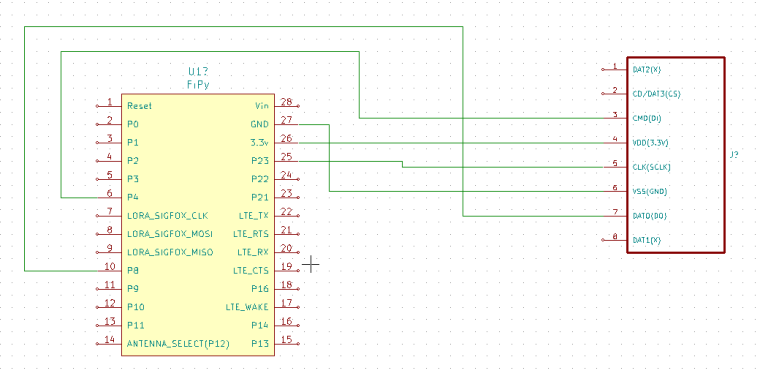
                            @jmarcelino Would this wiring work?

                            0_1549934788017_aba064d6-d4e9-4383-86bc-da3e0aafb20a-image.png

                            robert-hhR 1 Reply Last reply Reply Quote 0
                            • robert-hhR Offline
                              robert-hh @Edward Dimmack
                              last edited by

                              @edward-dimmack That should work. I'm using this wiring on my homebrew interface boards.

                              1 Reply Last reply Reply Quote 1

                              Hello! It looks like you're interested in this conversation, but you don't have an account yet.

                              Getting fed up of having to scroll through the same posts each visit? When you register for an account, you'll always come back to exactly where you were before, and choose to be notified of new replies (either via email, or push notification). You'll also be able to save bookmarks and upvote posts to show your appreciation to other community members.

                              With your input, this post could be even better 💗

                              Register Login
                              • 1
                              • 2
                              • 1 / 2
                              • First post
                                Last post

                              Pycom on Twitter

                              Pycom