Ping-Pong Example Reset
-
@burgeh I do not know. According to your tests, it is related to the sending device, that's why I wanted to tell, whether the device is still sending. If yes, either the content of could have changed (not "Ping"), or some other frequency was used, or ...... But I could net get a stable fault condition.
-
@robert-hh Sorry misinterpreted that a little bit. Yes the node_B is still sending from what I can tell. Looking at the code it still flashes blue and green. However, looking at it now maybe the s.send is in some error state and may be just failing (but the code would still blink).
-
@burgeh The flashing just shows that the loop still continues. That's what I assumed, because of the print statement in the loop. But I wanted to see if still the RF signal is present.
-
@robert-hh What would you suggest I use to detect if it is still present? I don't have a spectrum analyzer on hand.
-
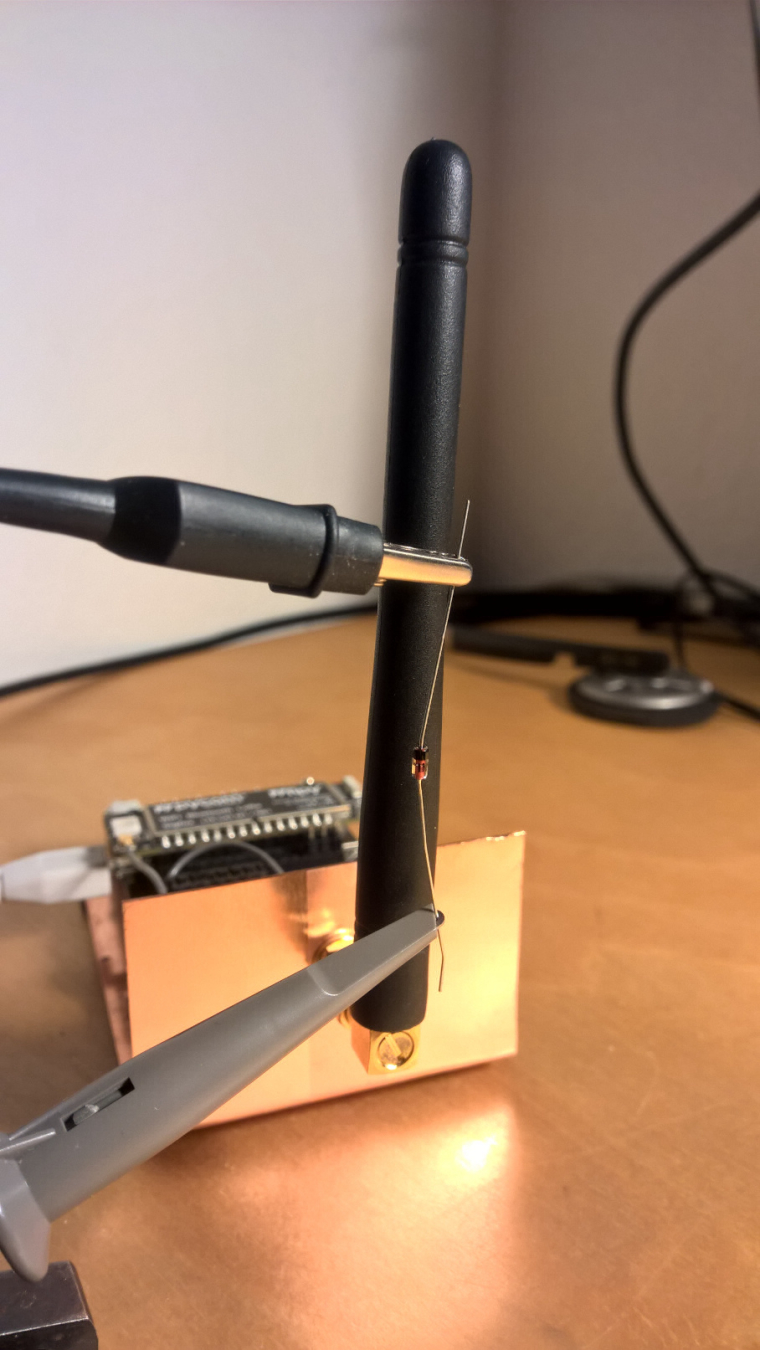
@burgeh If you have an oscilloscope and a diode, you can use that, like shown in the picture below. The diode shown is a 1N4148, but a Schottky diode (e.g. BAR11) gives a stronger signal. The bandwidth of the oscilloscope does not matter, since the RF signal is rectified. It picks up the current, that's why in the picture the diode is at he bottom of the quarter wave antenna. For the PyCom antenna, you get the strongest signal with the diode body 4 cm away from the tip. If just shows the presence of RF, not the frequency.
-
@robert-hh What exactly should I look for? Won't 60Hz drown out such a low power signal? Also the signal is at 916 MHz I don't think many scopes (including mine) can go up that high. I have a schottky 1N5817 and did some basic testing to see if anything shows up...pretty inconclusive, doesn't change if the system is on or off it seems.
-
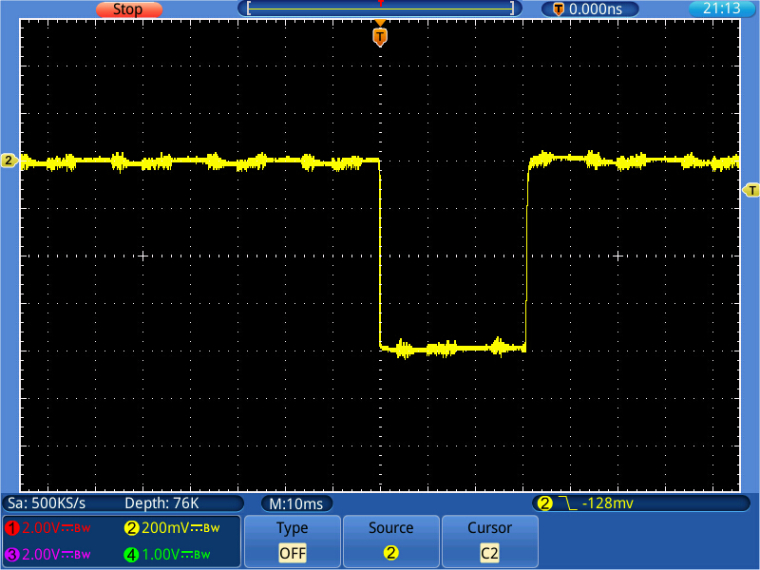
@burgeh A 1N5817 might be too slow (capacitance 110pF). You would see a DC voltage when the device is sending. Below is a picture of the "Ping" Sending from lopy_b.py script. The Diode used is a 1N4148 (small signal, silicon, capacitance 4 pf). The level is 800mV,. With a fast schottky diode (BAR 11, capacitance 1.2 pF) I have seen up to 1.5V, so the noise does not matter. If the Anode of the diode is at GND, you have a negative pulse, if the anode is at the tip, a positive pulse. I used the x10 probe.
-
@robert-hh Using a 1N4148 this is what I keep getting. I'm using a foreign oscilloscope, but I believe I have it set like yours (10ms/div, 100mv/div. I also set triggers both rising and falling edge around +-50mV and get nothing. Below are some images ( had issues with the normal insert on here). How close are you to your node A?
Osc. when just reading http://tinypic.com/r/wjuzbq/9
-
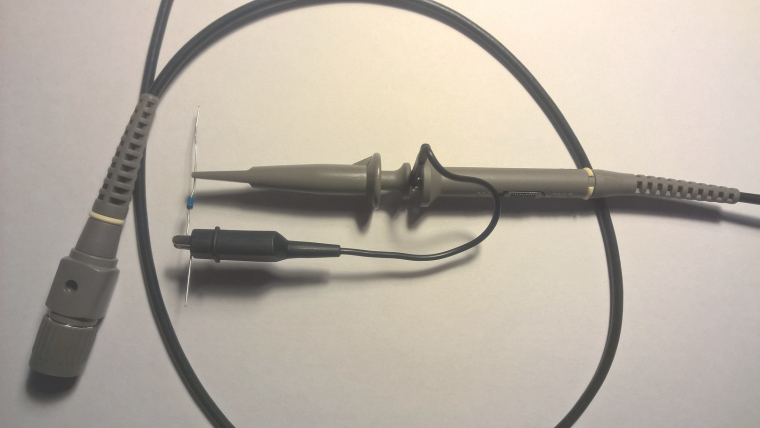
@burgeh The diode must be immediately on the surface of the antenna, like shown on the picture. The Oscilloscope is fine for the purpose. The probe is not. You should use a proper 10:1 oscilloscope probe with low capacitance. At 10:1 it should be around 3 pF. They normally come bundled with the oscilloscope. If pictures are too large, you cannot upload them. Therefore I scale them down first.
Edit: Siglent is a good brand. LeCroy relabels Siglent devices for their budget series. -
@robert-hh Yeah I figured those cables could be an issue, I don't have the original set, I'll find some better probes and report my findings. Thanks thus far for the help!
-
@robert-hh I finally got a new probe, and I was able to confirm on an oscilloscope that it is no longer sending the 'Ping' after awhile.
-
This post is deleted!

Hello! It looks like you're interested in this conversation, but you don't have an account yet.
Getting fed up of having to scroll through the same posts each visit? When you register for an account, you'll always come back to exactly where you were before, and choose to be notified of new replies (either via email, or push notification). You'll also be able to save bookmarks and upvote posts to show your appreciation to other community members.
With your input, this post could be even better 💗
Register Login