Welcome to the Pycom forum Forum
    • \[\[global:header.categories\]\]
    • \[\[global:header.recent\]\]
    • \[\[global:header.tags\]\]
    • \[\[global:header.popular\]\]
    • Login

    Explore Pybytes | Official Documentation | Report a Firmware Bug/Issue | GitHub

    Seek help about programming: How to send ultrasonic sensor data to gateway using LoRa OTAA ?

    Scheduled Pinned Locked Moved MicroPython
    lopyexpansion boardotaaultrasonic senslora
    17 Posts 4 Posters 3.6k Views 4 Watching
    Loading More Posts
    • Oldest to Newest
    • Newest to Oldest
    • Most Votes
    Reply
    • Reply as topic
    Log in to reply
    This topic has been deleted. Only users with topic management privileges can see it.
    • robert-hhR Offline
      robert-hh @Rachelsimida
      last edited by

      @rachelsimida said in Seek help about programming: How to send ultrasonic sensor data to gateway using LoRa OTAA ?:

      s.send(bytes([binascii.b2a(distance) % 256]))

      This line is flagged as wrong.
      If you want to send it as a readable byte string, it would be something like:
      s.send(str(distance).encode())
      or base64-encoded
      s.send(binascii.b2a_base64(str(distance)))

      Besides that, the last line should be indented, to be in the loop.

      R 1 Reply Last reply Reply Quote 1
      • R Offline
        Rachelsimida @robert-hh
        last edited by

        @robert-hh THANK YOU SO MUCH! It works when I use "s.send(str(distance).encode())".
        While the "s.send(binascii.b2a_base64(str(distance)))" stills shows the invalid syntax.
        Anyway, it helps me solve the problem.
        The issue confused me couples of days. Now the gateway received the data like this:0_1519937117763_1.PNG

        I wonder know if the data can be changed another way that reads more simple and people can easily know the contents. Because u know the byte string looks so complex.0_1519937545666_2.PNG
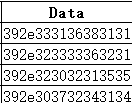
        If the data must be showed like this, can you tell me the program to inverse these data to read the real distance from ultrasonic sensor. Because I need process these date in the Matlab later.

        robert-hhR 2 Replies Last reply Reply Quote 0
        • robert-hhR Offline
          robert-hh @Rachelsimida
          last edited by

          @rachelsimida it's Ascii-characters, displayed as hex.

          1 Reply Last reply Reply Quote 0
          • robert-hhR Offline
            robert-hh @Rachelsimida
            last edited by

            @rachelsimida The variant "s.send(binascii.b2a_base64(str(distance)))" did not work, because the first line of your code is wrong. it should be:
            import binascii
            Nevertheless, something like:
            '392e32303131' ist just the hex representation of the text '9.2011'.
            You could convert than with binascii.unhexlify('392e32303131') into b'9.2011'
            or if you like a string instead a bytes object with
            binascii.unhexlify('392e32303131').decode() into '9.2011'

            1 Reply Last reply Reply Quote 0
            • robert-hhR Offline
              robert-hh @Rachelsimida
              last edited by

              @rachelsimida You can also send that as json string, like:

              import ujson  # put that into the import section
              
              s.send(ujson.dumps({"dist" : distance}).encode())
              

              That should give you readable data in the TTN log.

              R 1 Reply Last reply Reply Quote 0
              • R Offline
                Rachelsimida @robert-hh
                last edited by

                @robert-hh Very thanks.
                The " binascii.unhexlify('392e32303131').decode() "works like 0_1519991407304_11.PNG

                The" s.send(ujson.dumps({"dist" : distance}).encode()) "works like0_1519991459585_22.PNG

                robert-hhR 1 Reply Last reply Reply Quote 0
                • robert-hhR Offline
                  robert-hh @Rachelsimida
                  last edited by

                  @rachelsimida The intention of TTN is not to get the values from the TTN console, but set up your own server which finally receives teh messages. At that point, they are decoded.
                  If you look at the integrations tab, you can create there an message endpoint. For testing, you can define tes server whuch just collects your data. Click "get started creating one", then "HTTP Integration", ans there you can specify an server for receiving POST messages form TTN with your data.
                  "For testing, a website called RequestBin (https://requestb.in/) may be used to receive the data that TTN forwards (via POST Request). To set this up, navigate to RequestBin and click the Create a RequestBin." You'll get an URL, which you can paste into the HTTP Intergration form.

                  R 2 Replies Last reply Reply Quote 0
                  • R Offline
                    Rachelsimida @robert-hh
                    last edited by

                    @robert-hh Thank you so so so much for your patience.

                    1 Reply Last reply Reply Quote 0
                    • R Offline
                      Rachelsimida @robert-hh
                      last edited by

                      @robert-hh Thank you robert-hh. I have solved the previous issues. It seems like you are an expert of this area. May I ask you a new question.
                      Next I want to design the deep sleep mode of my project for power save. Awake the device when we need it work. If the board can realize this function? Because I find it's different from pysense and pytrack, which has this function directly. Would you mind give me some direction?

                      robert-hhR 1 Reply Last reply Reply Quote 0
                      • robert-hhR Offline
                        robert-hh @Rachelsimida
                        last edited by

                        @rachelsimida sorry, I never tried deepsleep. But there is a lot of diskussion around.

                        R 1 Reply Last reply Reply Quote 0
                        • R Offline
                          Rachelsimida @robert-hh
                          last edited by

                          @robert-hh Thank you.

                          sebS 1 Reply Last reply Reply Quote 0
                          • sebS Offline
                            seb @Rachelsimida
                            last edited by

                            @rachelsimida

                            The LoPy, SiPy and WiPy2 need to use either a Deep sleep shield, pysense or pytrack to get a low sleep current draw. On the newer modules, this is not required and they can directly use the ESP32 processor's deep sleep function with only 15uA current draw.

                            R 1 Reply Last reply Reply Quote 0
                            • R Offline
                              Rachelsimida @seb
                              last edited by

                              @seb Thanks for your guide. Such a pity my teacher only give me the original modules. It's a course project for me. So apart from deep sleep mode, if there exists other way to help the LoPy+ Expansion board+ ultrasonic sensor save power?

                              sebS 1 Reply Last reply Reply Quote 0
                              • sebS Offline
                                seb @Rachelsimida
                                last edited by

                                @rachelsimida

                                You can still use the ESP32's deep sleep to lower the modules current consumption down to 15mA, but with a deep sleep shield this will go down to 15uA or so. If your teacher ordered direct from pycom or not he should have received deep sleep shields with his order. If not he can request some for free by emailing salessupport@pycom.io

                                1 Reply Last reply Reply Quote 0
                                • A Offline
                                  ambropete
                                  last edited by

                                  Hello @Rachelsimida ,
                                  I am facing issues sending data from Hc-sr04 to Pysense. Could you please upload your working code? This would be really great!!

                                  R 1 Reply Last reply Reply Quote 0
                                  • R Offline
                                    Rachelsimida @ambropete
                                    last edited by

                                    @ambropete

                                    import binascii
                                    import pycom
                                    import socket
                                    import time
                                    import ujson  # put that into the import section
                                    from network import LoRa
                                    from machine import Pin, Timer
                                    
                                    echo = Pin(Pin.exp_board.G7, mode=Pin.IN)
                                    trigger = Pin(Pin.exp_board.G8, mode=Pin.OUT)
                                    
                                    # Colors
                                    off = 0x000000
                                    red = 0xff0000
                                    green = 0x00ff00
                                    blue = 0x0000ff
                                    
                                    # Turn off hearbeat LED
                                    pycom.heartbeat(False)
                                    
                                    # Initialize LoRaWAN radio
                                    lora = LoRa(mode=LoRa.LORAWAN)
                                    
                                    # Set network keys
                                    app_key = binascii.unhexlify('11 22 33 44 55 66 77 88 99 00 11 22 33 44 55 65'.replace(' ',''))
                                    app_eui = binascii.unhexlify('00 00 00 00 00 00 00 00'.replace(' ',''))
                                    
                                    # Join the network
                                    lora.join(activation=LoRa.OTAA, auth=(app_eui, app_key), timeout=0)
                                    pycom.rgbled(red)
                                    
                                    # Loop until joined
                                    while not lora.has_joined():
                                        print('Not joined yet...')
                                        pycom.rgbled(off)
                                        time.sleep(0.1)
                                        pycom.rgbled(red)
                                        time.sleep(2)
                                    
                                    print('Joined')
                                    pycom.rgbled(blue)
                                    
                                    s = socket.socket(socket.AF_LORA, socket.SOCK_RAW)
                                    s.setsockopt(socket.SOL_LORA, socket.SO_DR, 5)
                                    s.setblocking(True)
                                    
                                    trigger(0)
                                    chrono = Timer.Chrono()
                                    
                                    while True:
                                        chrono.reset()
                                        trigger(1)
                                        time.sleep_us(10)
                                        trigger(0)
                                        while echo() == 0:
                                            pass
                                        chrono.start()
                                        while echo() == 1:
                                            pass
                                        chrono.stop()
                                        distance = chrono.read_us() / 58.0
                                        s.send(str(distance).encode())
                                        pycom.rgbled(green)
                                        time.sleep(0.5)
                                        pycom.rgbled(blue)
                                        time.sleep(0.5)
                                        print("Distance {:.0f} cm".format(distance))
                                        time.sleep(5)

                                    1 Reply Last reply Reply Quote 0

                                    Hello! It looks like you're interested in this conversation, but you don't have an account yet.

                                    Getting fed up of having to scroll through the same posts each visit? When you register for an account, you'll always come back to exactly where you were before, and choose to be notified of new replies (either via email, or push notification). You'll also be able to save bookmarks and upvote posts to show your appreciation to other community members.

                                    With your input, this post could be even better 💗

                                    Register Login
                                    • 1 / 1
                                    • First post
                                      Last post

                                    Pycom on Twitter

                                    Pycom