DHT 11 sensor always return same value
-
@robert-hh
Correct, 300 (not even 500) samples seems way too small for something like that.We saw in the pin interrupts experiments that toggling a Pin between (0) and (1) takes about 2-6 μS, so I'd expect reading should be similar maybe 1-2 μS.Total time for a reading from the DHT11 is 23.4 ms or 23400 μS so you really want to take and store at least the same (23400) samples to have a chance.(corrected in later reply, a buffer of 300 samples should suffice)Since we're only discerning between 28 μS (0) and 70 μS (1) pulses with 50 μS between them to me the more reasonable option is to simple add a small delay to the loop. But then you want to make sure it's properly calibrated/tested to the needs.
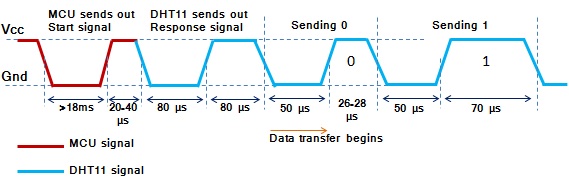
But again I'd strongly suggest moving on from the DHT11. It's a really cheap and nasty device. Anything that needs disabling IRQs especially in a LoRa device like the LoPy is a "bad idea"
-
@jmarcelino The loop is a little bit slower than 1-2µs, because the loop management needs time too. But that has to be determined. So without real timing testing cou cannot get any results. There were people who managed to get this type of code working on ESP8266.
Nevertheless, knowing about the irreular timing of the esp devices, it's better to use sensors with a stanard communication method. -
Just noticed the original poster is also using G4 (P14) which is an input-only pin, so trying to set it high dht_pin(1) does nothing. This means the DHT11 is not initialising.
-
@jmarcelino Right, that's whatI wanted to check too. But at that point the docs at machine.pin should spend a few words about it. Normal users would not look into the esp32 data sheet.
-
@robert-hh
You don't need to look into the esp32 data sheet, it's on the LoPy pinout map with a red warning sign: https://docs.pycom.io/pycom_esp32/_downloads/lopy_pinout.pdf"Only Input pins!"
The pinout map should really be required reading for everyone. Maybe the text could be made larger.
By the way I tested the loop - you are absolutely right I was overlooking the loop and memory access involved - each cycle takes about 20 μS. So perhaps 1200 samples could be enough.
-
@jmarcelino If a cycle takes 20 µs, and the actual reading time is less than 5 ms (160 µs lead in and 40 bits at 120µs worst case), then 250 samples are sufficient. So with 300 takes the buffer is large enough. So taking the wrong Input is the first thing to change.
-
@robert-hh
Good catch, I was going by the datasheet which states 23ms for a read, but that includes the initial delay already accounted for in the code.So in summary @bihut :
-Change power supplt to 3.3v
-Use another Pin that isn't input only (so don't use G5, G4, G0, G3, G31, G30) -
@bihut I gave your code a try, and as @jmarcelino saidm
- the port was wrong, and
- the first trailing 0/1 change was not detected because python was busy with changing functions.
The attached code works with my AM2302, which is identical to DHT22.
from machine import enable_irq, disable_irq,  Pin
import time
_LIMIT = const(8)
_BUFFERSIZE = const(1000)

def getval(pin) :
    ms = [1] * _BUFFERSIZE
    pin(0)
    time.sleep_us(20000)
    pin(1)
    irqf = disable_irq()
    mslen = len(ms)
    for _ in range(mslen):
        ms[_] = pin()      ## sample input and store value
    enable_irq(irqf)
    return ms

def decode(inp):
    res= [0]*5
    bits=[]
    ix = 0
    try:
        if inp[0] == 1 : ix = inp.index(0, ix) ## skip to first 0
#        ix = inp.index(1,ix) ## skip first 0's to next 1
#        ix = inp.index(0,ix) ## skip first 1's to next 0
        while len(bits) < len(res)*8 : ##need 5 * 8 bits :
            ix = inp.index(1,ix) ## index of next 1
            ie = inp.index(0,ix) ## nr of 1's = ie-ix
            bits.append(ie-ix)
            ix = ie
    except Exception as err:
        print (err, ix, len(bits))
        return([0xff,0xff,0xff,0xff])

    for i in range(len(res)):
        for v in bits[i*8:(i+1)*8]:   #process next 8 bit
            res[i] = res[i]<<1  ##shift byte one place to left
            if v > _LIMIT:
                res[i] = res[i]+1  ##and add 1 if lsb is 1

    if (res[0]+res[1]+res[2]+res[3])&0xff != res[4] :   ##parity error!
        print("Checksum Error")
        res= [0xff,0xff,0xff,0xff]

    return(res[0:4])

def DHT11(pin):
    res = decode(getval(pin))
    temp = 10*res[0] + res[1]
    hum = 10 * res[2] + res[3]
    return temp, hum

def DHT22(pin) :
    res = decode(getval(pin))
    hum = res[0]*256+res[1]
    temp = res[2]*256 + res[3]
    if (temp > 0x7fff):
        temp = 0x8000 - temp
    return temp, hum

dht_pin=Pin('G7', mode=Pin.OPEN_DRAIN)
dht_pin(1)

temp, hum = DHT11(dht_pin)

temp_str = '{}.{}'.format(temp//10,temp%10)
hum_str = '{}.{}'.format(hum//10,hum%10)

# Print or upload it
print(temp_str, hum_str)
It matches with a 10% difference with two cheap commercial temp/humidity devices I have, but I cannot tell which is right or wrong
Update: After an hour of settling, the two sensors show almost identical readings. -
@robert-hh A slight re-arrangement of lines in getval() made the capture get the leading '0' bit. That also tells how critical the timing is. Still, even with IRQ disabled, sometimes transitions are missing.
from machine import enable_irq, disable_irq, Pin import time _LIMIT = const(8) _BUFFERSIZE = const(1000) def getval(pin) : ms = [1] * _BUFFERSIZE mslen = len(ms) pin(0) time.sleep_us(20000) pin(1) irqf = disable_irq() for _ in range(mslen): ms[_] = pin() ## sample input and store value enable_irq(irqf) return ms def decode(inp): res= [0]*5 bits=[] ix = 0 try: if inp[0] == 1 : ix = inp.index(0, ix) ## skip to first 0 ix = inp.index(1,ix) ## skip first 0's to next 1 ix = inp.index(0,ix) ## skip first 1's to next 0 while len(bits) < len(res)*8 : ##need 5 * 8 bits : ix = inp.index(1,ix) ## index of next 1 ie = inp.index(0,ix) ## nr of 1's = ie-ix bits.append(ie-ix) ix = ie except Exception as err: print (err, ix, len(bits)) return([0xff,0xff,0xff,0xff]) for i in range(len(res)): for v in bits[i*8:(i+1)*8]: #process next 8 bit res[i] = res[i]<<1 ##shift byte one place to left if v > _LIMIT: res[i] = res[i]+1 ##and add 1 if lsb is 1 if (res[0]+res[1]+res[2]+res[3])&0xff != res[4] : ##parity error! print("Checksum Error") res= [0xff,0xff,0xff,0xff] return(res[0:4]) def DHT11(pin): res = decode(getval(pin)) temp = 10 * res[0] + res[1] hum = 10 * res[2] + res[3] return temp, hum def DHT22(pin) : res = decode(getval(pin)) hum = res[0]*256+res[1] temp = res[2]*256 + res[3] if (temp > 0x7fff): temp = 0x8000 - temp return temp, hum def run(): dht_pin=Pin('G7', mode=Pin.OPEN_DRAIN) dht_pin(1) temp, hum = DHT11(dht_pin) temp_str = '{}.{}'.format(temp//10,temp%10) hum_str = '{}.{}'.format(hum//10,hum%10) # Print or upload it print(temp_str, hum_str) run() -
This post is deleted! -
hello,
if someone can try my dht11 class and say me if it works for him.
It seems to be OK with a SiPy powered with USB .
DHT11_PyComFriendly, J.P


Hello! It looks like you're interested in this conversation, but you don't have an account yet.
Getting fed up of having to scroll through the same posts each visit? When you register for an account, you'll always come back to exactly where you were before, and choose to be notified of new replies (either via email, or push notification). You'll also be able to save bookmarks and upvote posts to show your appreciation to other community members.
With your input, this post could be even better 💗
Register Login