• Deep Sleep and Battery Consumption.

    LoPy ttn lopy deep sleep battery consumption lora
    18
    0 Votes
    18 Posts
    182 Views
    H
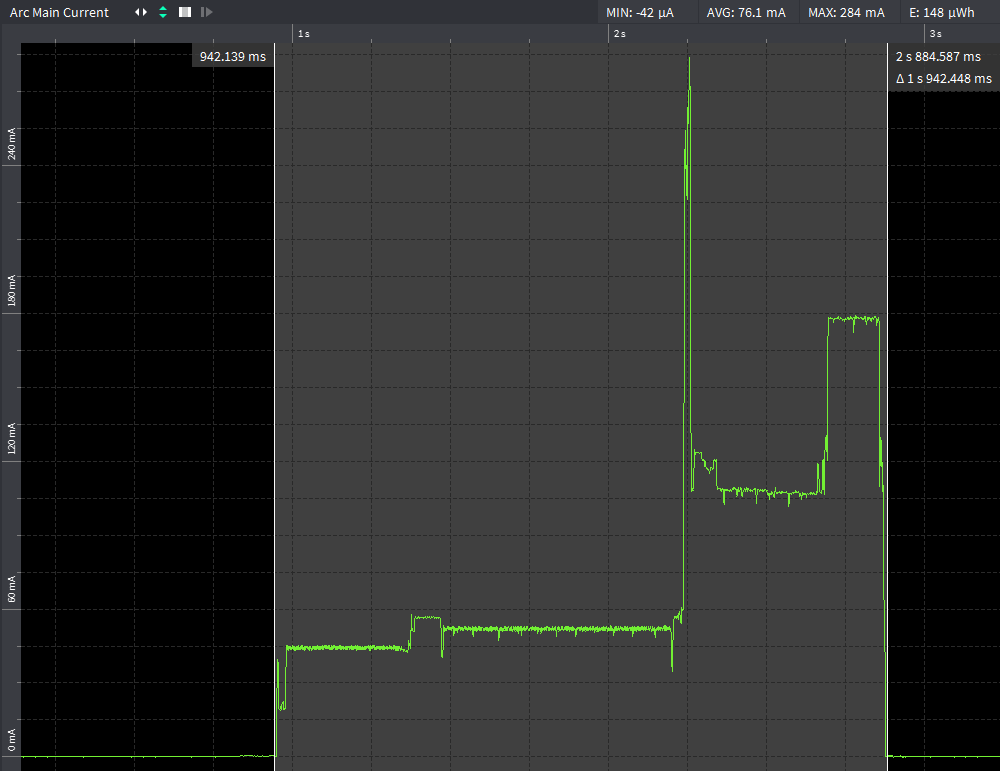
    @jcaron So you get a curve that varies during the whole awake time between 30 and over 100 mA. Ah I see. I think I confused myself when I saw the LoRa transmit in the documentation of 105mA and thought it was somehow the overall current draw of the awake time because it was similar to the 100mA you had mentioned before but I get it now. So the current draw is about 100mA (conservative) on average over the awake time. You've been a really great help. Thanks for all your patience :)
  • 0 Votes
    3 Posts
    519 Views
    rcolisteteR
    @protonx Look at : microsd-power-consumption-on-expansion-board-pytrack-pysense-etc "Conclusions to save power during deep sleep with Expansion Board : it is important to use only TX/RX jumpers, or else we will have extra 0.06 mA; large voltage values implies some extra (e.g., 0.02) mA; avoid using uSD cards, because even just inserting a uSD card, not mounted, without open files before deep sleeping, there is an increase in deep sleep current, depending on the type of uSD, e. g., extra 0.21-0.24 mA for a 8GB uSD, extra 0.12-0.14 mA for a 32GB uSD."
  • 0 Votes
    2 Posts
    798 Views
    J
    @lukesaber To compute your power requirements, if you are running a "wake up, send data, go back to sleep" pattern: define T as the duration in seconds of reference period of your choice (1 hour = 3600, 1 day = 86400...) define N as the number of times your device will wake up in that period define D as how long your device will we awake each time it wakes up (in seconds) define IA as the power consumption when awake (in mA, but you can use any unit as long as it's the same for IS and the result) define IS as the power consumption when sleeping (ditto) Then the average power consumption is: (N * D * IA + (T - N * D) * IS) / T Example: T = 3600 (1 hour) N = 3 (wakes up 3 times an hour) D = 10 (stays awake for 10 seconds) IA = 100 mA (average power consumption while awake) IS = 0.010 mA (10 µA, average power consumption while sleeping) Then the average power consumption is: (3 * 10 * 100 + (3600 - 3 * 10) * 0.010) / 3600 = 0.84325 mA If you want to have enough power for 2 days, then you need a battery with a 40 mAh capacity (0.84325 * 24 * 2). I think nearly any battery will do. Now, the exact figures for D, IA and IS can vary a lot, based on: what sensors/peripherals you may have that you need to power, and whether you power them all the time or only when you are awake what you need to do while awake how you send (LoRa, SigFox, LTE, Wi-Fi, BLE...), at what power level, at what data rate how long it takes for handshakes, ACKs, receive windows, etc. and probably a lot more things. Ignoring any sensors or other peripherals, while awake, the power consumption is usually somewhere between 50 mA (module active, not sending or receiving) and 200 mA (when sending). How long you stay awake will usually range between 3 and 10 seconds. Power consumption during deep sleep should be somewhere between 10 and 20 µA depending on the exact setup. So with 3 wake-ups per hour, for 2 days of battery life, your worst case scenario, not counting any sensors or peripherals, (200 mA when active, 10 seconds active, 20 µA in deep sleep) is about 80 mAh. You need to add the requirements for your sensors/peripherals on top of that. If you don't go to deep sleep for whatever reason, then the figures are drastically different, but you can keep the same logic. Just replace IS with the power consumption while idling.

  • 0 Votes
    4 Posts
    795 Views
    P
    @gda45-78 Hi, don't you have loaded a back WLAN process on the board that consume too much ? (see your post 3 months ago in your profile). regards.
  • BLE & Low power

    Comments & Feedback ble bluetooth deepsleep consumption low power
    1
    0 Votes
    1 Posts
    482 Views
    No one has replied
  • 1 Votes
    7 Posts
    2k Views
    D
    @catalin I finally managed to perform tests of releases between 1.14.0.b1 and 1.18.0.b1. Otii ARK traces are available here: https://drive.google.com/open?id=1kIZL0HJHn_dEIPDM_jv6fEhDhb_Ukfqj Significant execution time increase occured between versions: 1.17.0.b1: MP: d0dc708a0197d2900a5620648725794a1fb5c8f3 IDF: 3b54cd7473aefdb8b75531a21ce340c4bd2221da and 1.17.2.b1: MP: 1bf377b08e2162e8534b6cbe78dcdeeb930f64b8 IDF: 4eab4e1b0e47c73b858c6b29d357f3d30a69c074
  • Higher power consumption on Lopy4

    LoPy lopy4 consumption usb regulator
    3
    0 Votes
    3 Posts
    927 Views
    T
    @jcaron Yeah pretty sure it's in deep sleep at that moment. This +50mA is constant in deepsleep but also in normal state. So for example it draws 160-170mA instead of 110-120mA on the other LoPy with the same configuration and program. And in sleep it consumes 50mA while the other one around 0.215mA. It might be a simple mismanipulation but it's still strange that it's exactly 50mA. On the next prototype I will try to check the consumption before seding it as a test just to be sure.
  • 0 Votes
    23 Posts
    10k Views
    C
    @cduplouy I am also getting around 15mA during deepsleep. I tried with 3.3v and 3.7v using resistor but then it is not sufficient power for the pycom to run.
  • 0 Votes
    3 Posts
    1k Views
    J
    @jcaron Thanks for your reply. 1.) I would say everything below 5 seconds is acceptable. 2. / 3.) This question is hard to answer, since I will try the device with different types of applications so the capacity of the batteries will strongly vary. The battery life should be as long as possible. I also found the machine.idle and machine.sleep in http://docs.micropython.org/en/latest/wipy/library/machine.html. Given the description machine.sleep should work if I trigger the LoPy through Wifi. Is that correct? Thanks in advance.
  • 0 Votes
    1 Posts
    775 Views
    No one has replied
  • 0 Votes
    2 Posts
    1k Views
    D
    This is what I came with. I did some limited tests with LoPy connected to 5V supply. T2 drain was connected to 3V3 output of LoPy, VBAT to P16 (set as ADC channel) and EN signal to P20 (set as output). I could measure some voltage with the ADC while EN pin was enabled (3V3). When set to 0V, ADC reading was 0V as well and current through T2 drain was around 30nA (measured using uCurrent). [image: 1504793749529-battery_voltage_measurement_circuit_v1-resized.png] @daniel @jmarcelino and others please comment if this circuit makes sense in your opinion. The goal is to limit the current through the voltage divider in between measurements - e.g. during deep-sleep of battery powered sensor.
  • 1 Votes
    7 Posts
    3k Views
    on4aaO
    @jmarcelino With pycom.wifi_on_boot(False), I started using rshell, which I truly enjoy. It allows me to keep on writing code with vim (instead of atom) whilst rendering the upload and running of scripts really easy. The rshell command line tool definitely also merits mentioning in the documentation.