Welcome to the Pycom forum Forum
    • \[\[global:header.categories\]\]
    • \[\[global:header.recent\]\]
    • \[\[global:header.tags\]\]
    • \[\[global:header.popular\]\]
    • Login

    Explore Pybytes | Official Documentation | Report a Firmware Bug/Issue | GitHub

    Current sensor 15A SCT-013

    Scheduled Pinned Locked Moved LoPy
    sensorcurrentlopy
    28 Posts 3 Posters 3.7k Views 3 Watching
    Loading More Posts
    • Oldest to Newest
    • Newest to Oldest
    • Most Votes
    Reply
    • Reply as topic
    Log in to reply
    This topic has been deleted. Only users with topic management privileges can see it.
    • V Offline
      Vicky_ @robert-hh
      last edited by Vicky_

      @robert-hh Hello. The coding you shared, it works! Thanks a lot.
      I use it to measure a hairdryer rated 1000w to 1200w.
      when hairdryer is off I get 0.something.
      when I open level 1 I get 10. something.
      when I open level 2 I get 45. something.
      when I open level 3 I get 71. something.
      I chose the maximum value 71.something and divide 512 (9 bits ADC) times with 3.3v and 15A.

      eg:
      ((71.22/512)*3.3)*15 = 6.86A

      but the maximum current should be 1200/240v =5A, right?

      or my calculation is wrong?

      I used it to measure a phone charger but it has no different with when it is off, maybe the current is too small.

      once again, thanks

      alt text

      robert-hhR 1 Reply Last reply Reply Quote 0
      • robert-hhR Offline
        robert-hh @Vicky_
        last edited by robert-hh

        @vicky_ The transfer ratio is hard to guess, because there are some unknown figures in between, like the transfer function of your sensor. That is 1Veff at 15A. So at 5 A it should deliver 0.333Veff. But i did never determine the remainder of the transfer function.
        What you should do is to take the current of the hairdryer with an known good Multimeter and determine a factor from that. The ESP32 ADC is non-linear, especially at 11 dB attenuation. But the mid range values should be OK. Using 6 dB attenuation the linearity is better. But then you'll need a different interface circuit.
        Yes, at low currents the ADC noise and the phase noise of the sampling steps in. If the time for reading a value is larger, you'll have somewhat less noise. This time should be a integer multiple of the wave period. For 50 Hz, a multiple of 20 is fine, for 60 Hz a multiple of 50. So taking a multiple of 100 is good for both frequencies.

        V 1 Reply Last reply Reply Quote 1
        • V Offline
          Vicky_ @robert-hh
          last edited by

          @robert-hh Thanks for your suggestion! I understand what you trying to say until this part "If the time for reading a value is larger, you'll have somewhat less noise. This time should be a integer multiple of the wave period. For 50 Hz, a multiple of 20 is fine, for 60 Hz a multiple of 50. So taking a multiple of 100 is good for both frequencies."

          do you mean that at the coding the time I should modify it
          time1 = time x 100 and all time change it to time1?
          sorry.

          robert-hhR 1 Reply Last reply Reply Quote 0
          • robert-hhR Offline
            robert-hh @Vicky_
            last edited by robert-hh

            @vicky_ in my example, the time for reading is 1000 = 1000ms. If that is too slow, you may take any multiple of 100, like 100, 200, 300, .... instead. Besides that, you can freely select the total measuring time.

            V 1 Reply Last reply Reply Quote 0
            • V Offline
              Vicky_ @robert-hh
              last edited by

              @robert-hh ok thank you so much!

              1 Reply Last reply Reply Quote 0
              • S Offline
                StefanoF @robert-hh
                last edited by StefanoF

                @robert-hh

                Hi,
                sorry Robert, because this schema is different of schema di Vicky? 957fd326-fdd1-45bf-b8b6-0878191859ce-image.png ,,
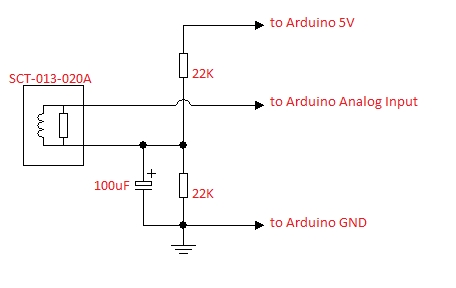
                can you kindly let me know which schema I need used?

                Many thanks

                robert-hhR 2 Replies Last reply Reply Quote 0
                • robert-hhR Offline
                  robert-hh @StefanoF
                  last edited by

                  @StefanoF They are identical in that they shift up the signal to be measured by Vdd/2. The difference:

                  • In my schematic the sensor is directly tied to GND, here it is tied to a virtual GND at Vdd/2 with a impedance at 50 Hz of about 30 Ohm.
                  • I added in my schematics overvoltage protection, which is missing here.

                  As long as there is no excess current you are try to measure, both will work. In case of a shortage in the sensed circuit, there is a high risk that the connected Pycom device will be damaged.

                  P.S.: To get a result for measuring, only C1, R1 and R2 are needed in my circuit. Everything else is for protection.

                  S 1 Reply Last reply Reply Quote 0
                  • robert-hhR Offline
                    robert-hh @StefanoF
                    last edited by

                    @StefanoF The schema in your post and the one of Vicky are identical, just differently sketched.

                    S 1 Reply Last reply Reply Quote 0
                    • S Offline
                      StefanoF @robert-hh
                      last edited by

                      @robert-hh Thanks for your suggestion!

                      1 Reply Last reply Reply Quote 0
                      • S Offline
                        StefanoF @robert-hh
                        last edited by robert-hh

                        @robert-hh

                        StefanoF 2 days ago
                        Hi ,
                        I've used this the electronic schema , I've in out 1.65 volt at empty, the sensor is at 15A (STC 013-015)
                        Can you kindly help me with easy code,

                        apin = adc.channel(pin='P13', attn=ADC.ATTN_11DB)
                        
                        peakVoltage = float(0)
                        ACCurrtntValue = float(0)
                        for i in range(5):
                            peakVoltage += apin.voltage()
                            utime.sleep_ms(1)
                        peakVoltage = (peakVoltage / 5)
                        voltageVirtualValue = (peakVoltage / 1000)
                        print(round(voltageVirtualValue,2))
                        

                        result 1.65

                        Many thanks

                        robert-hhR 1 Reply Last reply Reply Quote 0
                        • robert-hhR Offline
                          robert-hh @Vicky_
                          last edited by

                          This post is deleted!
                          1 Reply Last reply Reply Quote 0
                          • robert-hhR Offline
                            robert-hh @StefanoF
                            last edited by

                            @StefanoF You code snippet calculates the average DC voltage at the input. But what you need is the amplitude of the 50 Hz (or 60 Hz) AC voltage. So you have to do some kind of frequency analysis for that frequency. The most simple algorithm for doing that is the so called goertzel algorithm. If you scroll back in this thread, you will find an example which I posted there. I used that and it works fine, except for very small currents. But that is not the problem of the algorithm, that caused by the noise of the ADC capture, both amplitude and phase noise.

                            S 1 Reply Last reply Reply Quote 0
                            • S Offline
                              StefanoF @robert-hh
                              last edited by robert-hh

                              @robert-hh

                              Hi Robert,
                              I've used this my code e variabile ma è valido:
                              Thanks you

                              def readACCurrentValue():
                                  global RANGE_AMPS, ADJUST_VOLTAGE
                                  peakVoltage = float(0)
                                  ACCurrtntValue = float(0)
                                  for i in range(5):
                                      peakVoltage += apin.voltage()
                                      utime.sleep_ms(1)
                                  peakVoltage = (peakVoltage / 5) 
                                  voltageVirtualValue = round(peakVoltage / 1000,2) - 1.65   
                                  if(math.fabs(voltageVirtualValue)>0.1):
                                      ACCurrtntValue = (math.fabs(voltageVirtualValue) * 15)   #15 A
                                  return round(ACCurrtntValue,2)
                              
                              robert-hhR 1 Reply Last reply Reply Quote 0
                              • robert-hhR Offline
                                robert-hh @StefanoF
                                last edited by robert-hh

                                @StefanoF I think your code is not useful. It does not determine the value of the 50HZ AC component. Instead it calculate the average value of a 5ms time window somewhere in the 20ms period of a 50 Hz wave. For a given constant current you will get a largely varying output value, if you repeat the call several time non-synchronous with the mains frequency. And even is the value is in the synchronous case seemingly constant, it may be totally wrong.
                                I tried similar approaches, e.g. finding the highest and lowest value and then calculating the difference, like a Vpp determination. But that was not robust at all. The only robust approach was using a FFT approach, like the mentioned Goertzel algorithm.

                                S 1 Reply Last reply Reply Quote 0
                                • S Offline
                                  StefanoF @robert-hh
                                  last edited by

                                  @robert-hh

                                  Not exist a driver for this component , ex. EmonLib.h of arduino ?

                                  Many thanks

                                  robert-hhR 2 Replies Last reply Reply Quote 0
                                  • robert-hhR Offline
                                    robert-hh @StefanoF
                                    last edited by

                                    @StefanoF said in Current sensor 15A SCT-013:

                                    EmonLib.h, Emonlib.cpp

                                    I do not know a python implementation for that algorithm. As far as I understand is, if calculates the integral over the zero compensated voltage square. That can be done and may work for strong signals. I expect it to fail for small signals.

                                    1 Reply Last reply Reply Quote 0
                                    • robert-hhR Offline
                                      robert-hh @StefanoF
                                      last edited by robert-hh

                                      @StefanoF Here is another code, which uses plain vanilla calc instead of the goertzel algorithm. That is more robust to cumulating rounding errors. I have my doubts about that for goertzel. This also tries to cater for sampling jitter.

                                      #
                                      import gc
                                      import math
                                      import array
                                      from utime import ticks_us, ticks_ms, ticks_diff, sleep_ms
                                      from machine import ADC, Timer, idle, enable_irq, disable_irq
                                      
                                      #
                                      # acquire ADC values. The paramters of the constructor are:
                                      # 1. the mains frequency (number, typically 50 or 60)
                                      # 2. the time (ms) for one test period. time must be an integer
                                      #    multiple of frequency period duration and the sampling period
                                      #    being n * 50ms for 60Hz and n * 20ms for 50 Hz. A good value is 200
                                      # 3. the sampling period (ms). time must be an integer multiple
                                      #    of the sampling period. The default is 2.
                                      #
                                      class Acquire:
                                          def __init__(self, freq=50, *, time=200, sample_rate=2):
                                              self.sample_rate = sample_rate
                                              self.samples = time // sample_rate
                                              self.adc = ADC(bits=12)
                                              self.freq = freq
                                      
                                              self.data = array.array("f", [0.0 for _ in range(self.samples)])
                                              pi_f = (2 * math.pi * freq * self.sample_rate) / 1000
                                              self.timestamp = array.array("L", [0 for _ in range(self.samples)])
                                      
                                          def start(self, pin):
                                              self.pin_adc = self.adc.channel(pin=pin, attn=ADC.ATTN_11DB)
                                              self.count = 0
                                              self.busy = True
                                              self.alarm = Timer.Alarm(self.read_adc, 0, ms=self.sample_rate, periodic=True)
                                      
                                          def stop(self):
                                              self.alarm.cancel()
                                      
                                          def read_adc(self, alarm):
                                              self.data[self.count] = self.pin_adc.value()
                                              self.timestamp[self.count] = ticks_us()
                                              self.count += 1
                                              if self.count >= self.samples:
                                                  self.alarm.cancel()
                                                  self.busy = False
                                      
                                          def result(self):
                                              while self.busy == True:
                                                  sleep_ms(self.sample_rate)
                                              # normalize the time stamps
                                              for _ in range(1, self.count):
                                                  self.timestamp[_] = ticks_diff(self.timestamp[_], self.timestamp[0])
                                              self.timestamp[0] = 0
                                      
                                              vsin = 0.0
                                              vcos = 0.0
                                              pi_f = (2 * math.pi * self.freq) / 1000000
                                              for _ in range(self.count):
                                                  vsin += self.data[_] * math.sin(self.timestamp[_] * pi_f)
                                                  vcos += self.data[_] * math.cos(self.timestamp[_] * pi_f)
                                              amplitude = math.sqrt(vsin * vsin + vcos * vcos) / self.count
                                              gc.collect() # avoids automatic gc during sampling
                                              return amplitude
                                      
                                          def reading(self, pin):
                                              self.start(pin)
                                              return self.result()
                                      
                                      def run():
                                      
                                          pin = "P13"
                                          freq = 50
                                          meas_time = 1000
                                          acq = Acquire(freq, time=meas_time)
                                      
                                          try:
                                              for _ in range(100):
                                                  value = acq.reading(pin)
                                                  print(value)
                                          except:
                                              pass
                                          acq.stop()
                                          print("Handler stopped")
                                      
                                      run()
                                      
                                      S 1 Reply Last reply Reply Quote 0
                                      • S Offline
                                        StefanoF @robert-hh
                                        last edited by

                                        @robert-hh said in Current sensor 15A SCT-013:

                                        Goertze

                                        Many thanks Robert,

                                        I am attaching a files at empty (1.65 volt setoff)

                                        how should I interpret it ?
                                        Goertze.py

                                        robert-hhR 2 Replies Last reply Reply Quote 0
                                        • robert-hhR Offline
                                          robert-hh @StefanoF
                                          last edited by robert-hh

                                          @StefanoF I repeated the test with a real current set-up (variable 0..30V transformer and a 1 Ohm load resistor) and the attached script:
                                          at 0 current it outputs. 0.06 +/- 0.3
                                          at ~0.2 A it reports ~2.5
                                          at ~0.5A it reports ~6.9
                                          at 1 A it reports ~13.0
                                          at 2 A it reports ~26.0
                                          at 3 A it reports ~39.0
                                          at 4 A it reports ~52.0
                                          at 5 A it reports ~65
                                          at 6 A it reports ~78.2
                                          at 7A it reports ~92
                                          at 8 A it reports ~105
                                          at 9 A it reports ~118.7
                                          Then the fuse of the 5 A transformer supply tripped in and the load resistor got HOT. No fear. It is an extremely robust supply, used for teaching. And the load resistor is a 50W type with a short time overrating of 250W, surface temperature up to 275°C.
                                          So the values are good in a range from .2 A up. Lower current readings are noisy.

                                          #
                                          import gc
                                          import math
                                          import array
                                          from utime import sleep_ms, sleep_us
                                          from machine import ADC, Timer, idle, enable_irq, disable_irq, Pin
                                          
                                          #
                                          # acquire ADC values. The paramters of the constructor are:
                                          # 1. the mains frequency (number, typically 50 or 60)
                                          # 2. the sampling period (ms). The default is 2 ms.
                                          #
                                          class Acquire:
                                              def __init__(self, freq=50, *, sample_period=2):
                                                  self.sample_period = sample_period
                                                  self.omega = 2.0 * math.pi * freq / (1000 / sample_period)
                                                  self.coeff = 2.0 * math.cos(self.omega)
                                                  self.adc = ADC(bits=9)
                                          
                                              def start(self, pin, time=200):
                                                  gc.collect() # avoids automatic gc during sampling
                                                  self.pin_adc = self.adc.channel(pin=pin, attn=ADC.ATTN_11DB)
                                                  self.samples = time // self.sample_period
                                                  self.count = 0
                                                  self.busy = True
                                                  self.q1 = 0.0
                                                  self.q2 = 0.0
                                                  self.alarm = Timer.Alarm(self.read_adc, 0, ms=self.sample_period, periodic=True)
                                          
                                              def stop(self):
                                                  self.alarm.cancel()
                                          
                                              def read_adc(self, alarm):
                                                  self.q0 = self.pin_adc() + self.coeff * self.q1 - self.q2
                                                  self.q2 = self.q1
                                                  self.q1 = self.q0
                                                  self.count += 1
                                                  if self.count >= self.samples:
                                                      self.alarm.cancel()
                                                      self.busy = False
                                          
                                              def result(self):
                                                  while self.busy == True:
                                                      sleep_ms(self.sample_period)
                                          
                                                  # amplitude = 2 * math.sqrt(self.q1 * self.q1 +
                                                  #                           self.q2 * self.q2 -
                                                  #                           self.q1 * self.q2 * self.coeff) / self.count
                                                  # if phase is required:
                                                  real = self.q1 - self.q2 * math.cos(self.omega)
                                                  imag = self.q2 * math.sin(self.omega)
                                                  amplitude = 2 * math.sqrt(real * real + imag * imag) / self.count
                                                  phase = math.atan2(real, imag)
                                                  #
                                                  return amplitude
                                          
                                              def reading(self, pin, time):
                                                  self.start(pin, time)
                                                  return self.result()
                                          #
                                          
                                          while True:
                                              acq = Acquire(50) # 50 Hz
                                              value = acq.reading("P13", 1000)
                                              print (value)
                                          
                                          1 Reply Last reply Reply Quote 0
                                          • robert-hhR Offline
                                            robert-hh @StefanoF
                                            last edited by

                                            @StefanoF Just one question:
                                            are you living in a 50Hz or 60Hz mains region. For 60Hz you have to change the call to Acquire into Acquire(60).

                                            S 1 Reply Last reply Reply Quote 0

                                            Hello! It looks like you're interested in this conversation, but you don't have an account yet.

                                            Getting fed up of having to scroll through the same posts each visit? When you register for an account, you'll always come back to exactly where you were before, and choose to be notified of new replies (either via email, or push notification). You'll also be able to save bookmarks and upvote posts to show your appreciation to other community members.

                                            With your input, this post could be even better 💗

                                            Register Login
                                            • 1
                                            • 2
                                            • 2 / 2
                                            • First post
                                              Last post

                                            Pycom on Twitter

                                            Pycom