• 0 Votes
    2 Posts
    195 Views
    J
    @patrickl That's indeed what I would do: just "interconnect" the UART connected to the Pi with the LTE's UART, sending data receiving from one end to the other and vice versa. Then the modem will look like it's directly connected to the Pi. Just don't call LTE and make sure you have the same speed settings everywhere. An alternative would probably to do it over BLE, but that seems like quite some more work to me.
  • 0 Votes
    1 Posts
    275 Views
    No one has replied
  • 0 Votes
    2 Posts
    259 Views
    No one has replied
  • 0 Votes
    1 Posts
    280 Views
    No one has replied
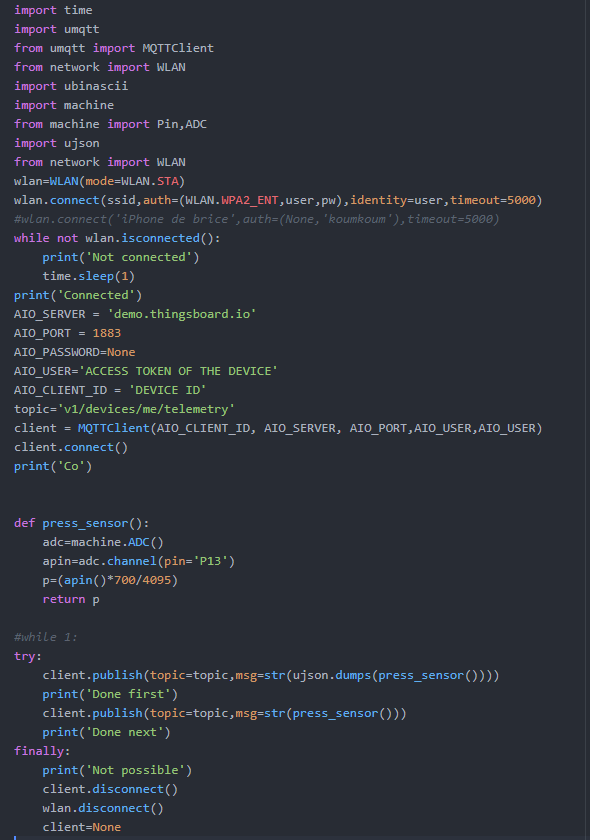
  • Communicate with Thingsboard using UMQTT

    MicroPython umqtt iot send data
    3
    1
    0 Votes
    3 Posts
    504 Views
    mfalkviddM
    @brossingo what was the output if the program when you ran it? Checking the return value of client.connect() might yield useful information.
  • lte = LTE()

    Issues & Bugs lte fipy network iot
    3
    0 Votes
    3 Posts
    506 Views
    J
    @paul-thornton Thanks for your input, the probmlem was that we had connected some sensors on the pins that was shared with LTE.
  • 0 Votes
    2 Posts
    699 Views
    D
    @bettina said in Can I use the PyGo on the Moon?: We’re also thinking of making some of the pins available on the PyGo device itself (whilst still retaining its IP67 properties)… I am glad to hear this. By implementing these pins the PyGo will become very interesting platform for wearable products for which using Enterprise cradle would be impractical. Please make sure that: it will be possible to power external circuitry from PyGo (and vice-versa?) it will be possible to init UART, I2C or SPI bus on available pins it will be possible to use of-the-shelf mating connector on the host device In my opinion it is also important that to find a way how to fix PyGo onto the host device without any structures required on the housing of the host device which would be too difficult to manufacture (mold, CNC-machine, 3D-print). Maybe magnets?
  • PYLIFE IS LIVE ON KICKSTARTER

    Pylife pylife wearable iot consumer iot mobile app
    5
    1 Votes
    5 Posts
    1k Views
    D
    @bettina Having exposed pins/pads available directly on PyGo would allow to use PyGo as a platform for wearables which could be extended via different peripheral and interfaces - e.g. NFC, barcode reader, etc. The cradle is not a solution for these use-cases. Another approach might be to offer "OEM" PyGo which could interface with custom PCB designed by developer. It could be just the PyGo PCB or a PCB with one side of housing (with touchscreen display). The other side would be designed by developer depending on custom circuits/PCB. I am looking forward for F01 to be released. Is it going to use the same pinout of current OEM modules? What about module size? Is it going to be bigger? I would be grateful for more details as we are currently developing new product which might significantly benefit from F01.
  • We're ready to Launch

    Pylife pylife wearables iot pymesh mesh
    4
    1 Votes
    4 Posts
    1k Views
    D
    Is this available for direct purchase?
  • The PYLIFE Kickstarter Preview Link is Live

    Pylife pylife iot wearables
    5
    1 Votes
    5 Posts
    1k Views
    E
    @Martinnn i guess they also included the esp32 community and the micro python community. although they didn't use the plural form
  • 0 Votes
    2 Posts
    548 Views
    danD
    Hi @nobo23 Are you trying to connect multiple sensors to the WiPy and communicate with them via Bluetooth? Connecting multiple BLE nodes to the WiPy is possible. You can find our BLE examples here. Hope this helps, let me know if you have any questions!
  • IOT Best communication between pyTrack

    Discussion pytrack ble iot wifi
    3
    0 Votes
    3 Posts
    605 Views
    G
    @bmarkus And what are the best values for getting that? (on EU zone)
  • Li-ion battery discharge

    Expansion Board battery power iot charging
    3
    0 Votes
    3 Posts
    1k Views
    sebS
    @robert-hh said in Li-ion battery discharge: bq24040 All of our boards use the same bq24040 circuit, therefore it is recommended to use batteries with a PCM to protect the battery from over discharge
  • AWS iot socket create error: -8567

    LoPy aws iot lopy
    12
    0 Votes
    12 Posts
    3k Views
    C
    Hello, I bumped on this very same issue when executing the below (partial) code. The socket create error -8576 showed up upon every attempt of executing the loop: while not pycomAwsMQTTClient.connect(): print("Waiting for AWS...") time.sleep(10) print('AWS connection succeeded!') Have found that the problem was on the root CA certificate. Just to recap, AWS "setup.py" file expects to work with three certificates as follows: AWS_ROOT_CA = "/flash/cert/root-CA.crt" AWS_CLIENT_CERT = "/flash/cert/thing.cert.pem" AWS_PRIVATE_KEY = "/flash/cert/thing.private.key" For some reason the root certificate was not created correctly upon instructions from AWS tutorials. To fix that, run the below command line on a Linux Terminal to download it again: curl https://www.amazontrust.com/repository/AmazonRootCA1.pem > root-CA.crt By doing so, my issue was fixed.
  • 0 Votes
    5 Posts
    1k Views
    F
    @seb thankyou so much 😉
  • 0 Votes
    7 Posts
    3k Views
    J
    @johanbrichau thanks for your example project! I am having trouble getting this to work based on your project. are you able to share an example of you config.py file? How do you load the rsa file and generate it?
  • Send SMS with FiPy via LTE-M1 control plane

    FiPy sms lte control plane iot fipy
    7
    0 Votes
    7 Posts
    3k Views
    A
    @jmarcelino ok, thx for this answer! Maybe i shoud introduce you into what my project is and you can tell me what the easiest way would be to implement this. In general i can say i want so send data from a Sensor to anywhere where i can catch the information from and i want so see it everywhere. This is what the IoT is for... ?. I don´t know realy much about programming, cellular network and internet protocols so my first idea was to send a sms or email. Now i know ist possible, but just with other providers or with detour. In my opinion it good to be independent as much as possible. I would like to use the internet via cellularnetwork . Thats why i chosed the GPY. The board can send from anywhere over LTE-NB-IoT. I hope in the near future i can put my sim-card inside the GPY and connect to the Internet. So this is the way i´ll send my data. Could this work?! :S But how to recieve and which transfer method would be good for sending via internet? Today i tried sending data with MQTT via WLAN. The example from https://www.hackster.io/bucknalla/mqtt-micropython-044e77 worked very good with my GPY! I also have seen that i can open my own MQTT-Server with https://mosquitto.org/ . Do you know: Would this also work with the LTE-module in the future? Is there a better solution you can recommend me? Maybe some thing with FTP- or MYSQL_Server(to heavy?)?! Thank you very much! Andy
  • Deployment with dev boards

    Comments & Feedback devkit oem iot
    4
    0 Votes
    4 Posts
    1k Views
    D
    @misterlisty Thanks for the info. I read your post.
  • LWM2M protocol!

    MicroPython iot server client m2m lopy lwm2m
    9
    0 Votes
    9 Posts
    3k Views
    R
    @ahaw021 Do you host your library somewhere? I have been running a pure C LWM2M client on bare-metal ESP32 with satisfying results. The implementation is based on https://github.com/Openhab-Nodes/libWakaamaEmb with DTLS support. I need to explore the possibility to use MicroPython as a base for LWM2M Hackathon. Cheers!